Long Term Investing
4 Advantages For The Long Term Investor
Long term investing is the last thing on the minds of most option traders. For most traders, the great lure of options is the possibility of generating big returns in a short amount of time.
Whether you're a net buyer of options dreaming of triple digit returns in a matter of days or weeks (and sometimes realizing those dreams), or whether you're a net seller of options writing credit spreads and striving to produce a viable and lucrative monthly cash flow business, once you've experienced options, it's hard to ever go back to straight buying and selling shares of stock.
Passive investing, be it through mutual funds, index funds, ETFs, or even some long forgotten buy and hold stock you've owned for years in an ignored account somewhere, is as incomprehensible to the options trader as obsessively analyzing a stock's price chart to determine short term areas of support and resistance is to the long term investor.
And yet, the options trader can learn a thing or two from the long term investor. It may seem odd, even counterintuitive, to suggest that short term instruments such as stock options be associated in any way with a long term investment horizon, but there are a number of powerful advantages to investing for the long haul, advantages that anyone interested in creating wealth would do well do consider:
4 Reasons Why a Long Term Investment Horizon Matters
- Long term investing makes it easier to focus on only high quality companies. How many times have we gotten ourselves in a predicament over the options of a stock whose shares we would never consider owning ourselves unless we were forced to do so at gun point?
When our criteria for selecting an option trade primarily involves amounts of premium and current chart technicals, we can easily find ourselves trafficking in mediocre securities. And mediocre securities, we learn through painful experience, are not always as predictable or as well-behaved as their charts suggest.
- Long term investing gives you time to recover if your position moves against you in the short term. Successful option trading requires not only that you be right about what a particular stock will do, but that you also be right on the timing. That's quite a combination.
The long term investor, however, only has to be right on the first part. By excluding near term timing requirements, the long term investor has the luxury of being protected against short term volatility or market irrationality.
That's a huge advantage and a very big reason why I believe that successful investing is easier than successful trading.
- The long term bias of the stock market is higher. Or rather, the long term bias of quality companies is higher. Long term, the outlook for most solid investments is relatively certain. Invest in quality companies at reasonable prices and then wait.
In almost every case, you'll have good returns and a substantially higher net worth than if you'd just squirreled your money away in a money market account.
And yet we option traders are invariably drawn to place trades in the short term where, no matter what our charts tell us, the outlook is far less certain. Yes, you can make a lot of money real fast in the options markets, but let's be honest--you can also lose a lot of money just as quickly.
- Long term investing (eventually) leads to automatic outsized returns.
Ultimately, this is the most powerful lesson that long term investing teaches us. It's the classic tale of the tortoise and the hare. The tortoise's formula for success is virtually guaranteed:
Consistent and Reasonably Good Rates of Return + The Power of Compounding + A Long Term Horizon = Sustainable Wealth.
For a powerful illustration, see the related High Dividend Stocks and Option Trading page.
With all this going for long term investing, should the rest of us stop trading options and just plow all our money into the stock of safe, conservative blue chip companies?
Not quite. But consider the following . . .
The Power of Long Term Investing Illustrated
Scenario 1 - Assume you make a $10,000 investment in a safe and stable stock paying a 3% dividend. And assume two other things - that the dividend grows by just 5% a year and that you spend the dividends rather than reinvest them.
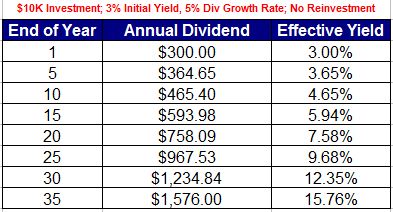
After 30 years, your original investment would be generating a 12.35% annual dividend. And, thanks to the power of compounding, assuming the dividend continued growing 5% yearly, the dividend rate based on your original investment would be accelerating.
Wait another five years and the rate jumps from 12.35% to 15.76%.
Double digit income with below average risk and no effort on your part. Isn't that pretty much every option trader's dream? Granted, you'd have to sit around and find something to do for three decades waiting for all this easy money to start coming in.
But keep in mind that Scenario 1 is based upon some VERY conservative numbers and assumptions:
- You don't reinvest the dividend (which would really compounded your returns)
- You assume a very conservative 5% dividend growth rate
- You begin with a fairly low dividend base of just 3%
True, you would have to wait 30 years, but no other effort or action is required, and you still come out pretty good.
In the real world, of course, you would presumably be adding new money, reinvesting your dividends, and hopefully experiencing a higher dividend growth rate, but Scenario 1 is designed primarily to illustrate the power that even modest dividend growth by itself can have on long term investments.
Now let's take a look at Scenario 2
Assume you make the same $10,000 investment with the same variables.
But instead of passively waiting for the decades to roll by, you instead choose to employ some relatively basic and safe Leveraged Investing option trading strategies from The Essential Leveraged Investing Guide to help speed up the process.
In short, in addition to the dividend payout, you're using options to generate additional modest amounts of income.
It's important to note that dividend income is income from the company's underlying business. It's part of the profits and profits are why you invested in the first place.
Option income, however, is income from your efforts. And the net effect of option income produced by a stock position you hold is that, in effect, it reduces your original cost basis.
So let's assume - very conservatively (even ridiculously so) - that through the use of options, you generate an additional 2% of income per year based on your original $10,000 investment, or $200 a year. Even on a low volatility (and therefore low premium) stock, that's still an extremely low bar.
The net effect is that the option income effectively lowers your original cost basis by $200 a year.
Let's assume further that you continue lowering your cost basis by just $200 a year.
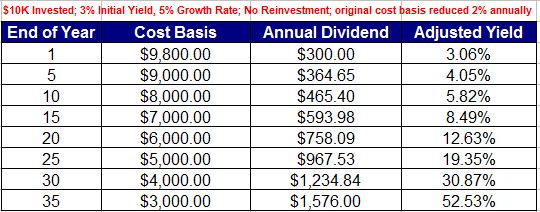
At the end of 30 years, your dividend rate alone wouldn't be 12.35%, but 30.87%.
And after 35 years? The traditional long term investing tortoise would be collecting an impressive 15.76%, but you, the much smarter tortoise, would be banking an astounding 52.53% "adjusted" dividend rate.
The Take Away
It's important to note that the dividend amount received in dollar terms is the same in both scenarios.
The difference is that in Scenario 2, you pay much, much less to acquire that dividend income than you do in Scenario 1 because Scenario 2 allows you to generate perpetual rebates off your initial investment.
It really comes down to what you do with those option-generated rebates. If you treat them like the dividend income in our examples and just spend them, then the difference between the scenarios is arbitrary.
The real power comes from reinvesting the proceeds of your option income. In the end, your "adjusted yield" as I call it, is only a number. But the tangible effect of reinvesting your option income is that you end up establishing a significantly larger dividend income stream from the same number of original investing dollars.
Finally, keep in mind that the original assumptions of these examples are extremely conservative. Using options to lower your cost basis by 2% a year is not difficult at all. And you can find numerous quality stocks with a dividend yield higher than 3% and with a dividend growth rate of more than 5%.
Make any of these variables more favorable by even a small amount, and you're going to significantly achieve long term investing success even more quickly.
Want more? Check out Adjusted Cost Basis with Options and Buy and Hold and Cheat.






>> The Complete Guide to Selling Puts (Best Put Selling Resource on the Web)
>> Constructing Multiple Lines of Defense Into Your Put Selling Trades (How to Safely Sell Options for High Yield Income in Any Market Environment)
Option Trading and Duration Series
Part 1 >> Best Durations When Buying or Selling Options (Updated Article)
Part 2 >> The Sweet Spot Expiration Date When Selling Options
Part 3 >> Pros and Cons of Selling Weekly Options
>> Comprehensive Guide to Selling Puts on Margin
Selling Puts and Earnings Series
>> Why Bear Markets Don't Matter When You Own a Great Business (Updated Article)
Part 1 >> Selling Puts Into Earnings
Part 2 >> How to Use Earnings to Manage and Repair a Short Put Trade
Part 3 >> Selling Puts and the Earnings Calendar (Weird but Important Tip)
Mastering the Psychology of the Stock Market Series
Part 1 >> Myth of Efficient Market Hypothesis
Part 2 >> Myth of Smart Money
Part 3 >> Psychology of Secular Bull and Bear Markets
Part 4 >> How to Know When a Stock Bubble is About to Pop