Long Call Option
I compare buying a long call option by itself to playing the slot machines at a casino. You can get lucky buying call options, but odds are that, over time, you're going to end up going home broke.
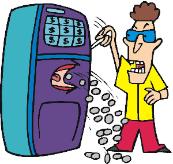
A long call option is a very simple trade. It consists of you buying 1 in the money (ITM), at the money (ATM), or out of the money (OTM) call option and then hoping like hell that the underlying stock immediately starts moving higher.
Long options are wasting assets.
A long option (whether long call or long put) consists of intrinsic value if it's in the money plus time value. As time passes, the option will lose value through time decay, with the amount of decay accelerating as expiration nears.
Strong moves to the upside (for the long call) can more than make up for any loss of time value. A long call on a stock that moves significantly higher is a powerful leverage that can result in astounding double, triple, and sometimes quadruple digit gains.
Call Options 101
As a reminder, what you're literally doing by purchasing a long call option is paying for the right to purchase 100 shares of stock at a certain price by a certain date. You do so because you believe that the stock will be higher by the time the option expires.
By purchasing a call option instead of 100 shares of actual stock, you only put up a fraction of the capital. Therefore your profits, and losses, will be magnified as you calculate your returns based on the investment cost of the options rather than the investment cost of 100 shares of the underlying stock.
In practicality, using a long call option by itself is a bet against the house in the hopes of hitting a jackpot. It's an aggressive bet on the near term upward move of a stock:
- If the stock remains flat, the value of the option steadily wastes away
- If the stock drops, the call loses value even more quickly
- If the stock falls hard, the call will most likely lose most of its value very quickly
- If you hold on to the long call until expiration, and the stock closes below the strike price, even by one cent, you will lose every penny of your original investment.
Of course, if the stock does what you hoped it would and moves sharply higher, your decision to purchase a long call will seem like the smartest thing you've ever done. Because, in effect, you're controlling 100 shares of stock at fraction of the cost of purchasing those 100 shares directly.
Long Call Example
Imagine that the XYZ Zipper Company has been trending higher recently and is now trading at $38/share.
You believe that the company's fundamentals and technicals are both sound and that the upward trend will continue.
You purchase a $40 call option expiring in one month for $1 (i.e. a $100 debit). This is an OTM call and consists solely of time value. If the stock closes anywhere at $40 or below, the option will expire worthless.
But let's suppose you were right about the stock. Positive news is released - velcro sales are way down, which bodes well for the zipper industry - and XYZ stock continues climbing higher.
By expiration, XYZ closes at $42/share. Your $1 call option is therefore $2 in the money ($42/share less the $40 strike price).
Presumably you would've closed out the long call prior to or right before expiration with a sell to close order and simply pocketed the profits (you bought the call for $100 and then sold it for $200, or thereabouts, for a $100, and 100%, profit).
If you held on to your call through expiration, you would wake up Monday morning to find that the long call had been excercised automatically and that you now have 100 shares of XYZ in your account purchased for $4000 (100 shares x $40 strike price). Your gains would be unrealized, but they would still be the same $100: $4200 current stock value less $4000 purchase price less $100 long call purchase price.
If you would've bought 100 shares of stock in lieu of the call option, you would've made $400 and about a 10.5% return ($400 divided by the $3800 original investment). But you also would've been exposed to downside risk in the stock. Theoretically, if something really terrible had happened and the stock traded down to zero, you would've lost up to $3800.
But with the call option, the most you could've lost was $100. And your ultimate return of $100 represents a 100% return on your invested capital.
Long Call Variations
Simply buying call options is an inherrently risky strategy since the stock HAS TO make a strong move upward, and in a certain time period, for you to make money.
It's also risky in that it's next to impossible to break even. You can almost bank on the assumption that you're going to get double digit returns. The only question is whether those returns will be negative or positive.
But like all option trading strategies, even a simple long call strategy can be made more or less risky. You can reduce risk by adjusting these factors:
- The Strike Price - The deeper in the money the strike price is, the more the call option is comprised of intrinsic value rather than time value. And it's time value that kills the buyer of options. Intrinsic value means there's something of real value there, something that will remain on Expiration Friday even if the stock doesn't get to where you wanted it to go. Obviously then, an ITM Call Option will require more capital upfront than its OTM counterpart, and on a percentage basis, the potential returns will be much less. But with an ITM option (and especially a DITM option), your risk of losing your entire investment is diminished.
- The Expiration Date - In the same way, the farther out in time the expiration date is, the more time you allow the stock to move higher. The downside, of course, that the farther out in time the expiration date is, the more you'll have to pay for the option. That again equates to a larger capital investment and therefore a reduction, on a percentage basis, of your potential returns.
Final Thoughts
If you're new to options, you should definitely be aware of some false logic that's routinely used by those promoting certain option trading services.
The sales pitch involves hyping the limitied capital risk aspect of options in general and trades like the simple long call in particular. And the sales pitch also also hypes the potentially huge percentage gains that are possible.
But you can't have it both ways, and it's misleading (and should be a red flag for you) when you someone's sales page where they're hyping both aspects.
After a successful trade, you can't go around saying, "I just made a 100% gain in twelve days! And I only risked $500!" A 100% return on $500 is still only $500. That equates to a 10% return on a $5,000 dollar investment and a 1% return on a $50,000 investment.
If you wanted a potential 100% return on your entire portfolio, then you'd have to put the entire thing at risk. But the point is - it really would be at risk.
It comes down to this - when you come across someone who suggests that it's possible to both make huge returns with options while lowering your overall risk, steer clear. You know one of two things - either that person is an idiot, or that person thinks you're an idiot.





>> The Complete Guide to Selling Puts (Best Put Selling Resource on the Web)
>> Constructing Multiple Lines of Defense Into Your Put Selling Trades (How to Safely Sell Options for High Yield Income in Any Market Environment)
Option Trading and Duration Series
Part 1 >> Best Durations When Buying or Selling Options (Updated Article)
Part 2 >> The Sweet Spot Expiration Date When Selling Options
Part 3 >> Pros and Cons of Selling Weekly Options
>> Comprehensive Guide to Selling Puts on Margin
Selling Puts and Earnings Series
>> Why Bear Markets Don't Matter When You Own a Great Business (Updated Article)
Part 1 >> Selling Puts Into Earnings
Part 2 >> How to Use Earnings to Manage and Repair a Short Put Trade
Part 3 >> Selling Puts and the Earnings Calendar (Weird but Important Tip)
Mastering the Psychology of the Stock Market Series
Part 1 >> Myth of Efficient Market Hypothesis
Part 2 >> Myth of Smart Money
Part 3 >> Psychology of Secular Bull and Bear Markets
Part 4 >> How to Know When a Stock Bubble is About to Pop