
Selling Puts
The Ultimate Guide for Put Sellers
of All Experience Levels
Selling puts is, hands down, my favorite investing strategy because it offers great returns while being enormously flexible and forgiving.
When approached sensibly, it's also MUCH safer than owning the underlying stock.
In this comprehensive and free resource, we're going to cover everything you need to know about selling put options safely and successfully.
Be sure to bookmark this page because you're going to want to come back to it again and again (and also consider sharing it with friends and family you believe would benefit from it).
Specifically, here's our table of contents:
- Chapter 1 - Put Selling Basics and Overview - What is a put option, how do you sell a put, and why would you want to?
- Chapter 2 - Selling Puts for Income vs. Selling Puts to Buy Stock at a Discount - There are only two viable reasons to sell puts - your job is to be clear on your purpose so you can then focus on maximizing your efforts.
- Chapter 3 - Best Stocks for Selling Puts - In this section, we look at important specific criteria when selecting an underlying stock on which to sell puts along with whether it's better to sell puts on value stocks or on growth stocks.
- Chapter 4 - How to Find Great Put Selling Trades - In Chapter 3, we looked at the type of stocks that are best for selling puts (and the type of stocks that aren't). In this chapter we're going to look at the specific conditions that represent attractive put selling set ups as I show you precisely how I go about finding great put selling trades.
- Chapter 5 - Best Position Size When Selling Puts - How many naked put contracts you sell when initiating a trade is vitally important, and in this section, I share what I believe is the best guideline for position size, why this guideline has served me well, and why you don't need to be overly rigid when using it.
- Chapter 6 - Managing, Adjusting, and Repairing Naked Puts - Being able to find great put selling trades, and knowing when and how to set them up, is only part of the battle. You also need to know how to most effectively manage your winning trades and how to safely repair your losing trades.
- Chapter 7 - Bonus Put Selling Resources - Want even more? This section includes a comprehensive collection of links to original articles covering all aspects of the put selling process. Enjoy!
Chapter 1 - Put Selling Basics and Overview
There are basically two reasons to sell put option contracts - to generate income or to acquire shares of a stock at a discount to the current market price.
We'll look at these two rationales in more detail in Chapter 2, but if you're new, or relatively new, to option trading, this chapter is about quickly getting you up to speed on the basics of put selling.
What Does it Mean to Sell (or Write) a Put?
The standard definition of a put option contract is that a put gives the holder (or buyer) the right to sell 100 shares of stock at a specific share price by a set date.
Basically, there are two ways of viewing short puts (i.e. the strategy of selling puts):
- Being paid to insure someone else's stock
- Being paid for offering to buy someone else's stock
I really like the insurance analogy. It translates well because puts are basically insurance for the share price of a stock.
Example: If you own 100 shares of XYZ and you purchase a put at the $30 strike price, you can exercise your contract up to the expiration date and "put" the shares to the put seller at $30/share.
In other words, you're insured at the $30 share price level - no matter how low the stock trades, you can exercise your contract and force someone else to buy your shares for $30/share.
As a put seller, that makes you the insurance company.
Ah, insurance - how boring, right?
Not in my view - especially when this form of insurance can be both lucrative and safe as we'll see.
But first, let's look at some key definitions and examples . . .
How to Sell a Put - Key Terminology
Like a lot of specialized topics, option trading has its share of jargon, but once translated into English, it's actually very easy to understand.
Here's the key terminology you need to know:
UNDERLYING - This simply refers to the underlying stock that you're selling the put against, be it Coca-Cola (KO), Microsoft (MSFT), Johnson & Johnson (JNJ), or any other optionable stock.
STRIKE PRICE - This is the price at which you're "insuring" the underlying stock. If the stock is trading at or above this price at expiration, the put will expire worthless. If it closes at expiration below the strike price, you will automatically be assigned the shares (these are basic definitions - later we'll explore the incredible flexibility of managing short options).
EXPIRATION DATE - As you might expect, this tells you the duration of the trade - just as a traditional insurance policy is only valid for a specific time frame, option contracts also have finite ending dates. Depending on the stock, you can select weekly expirations to options that don't expire for more than two years.
PREMIUM AMOUNT - This is the fun part, how much you get paid. Option prices are listed in what's called an Options Chain which includes the market makers current bid and ask prices (just like stock quotes) - but since each contract represents 100 share of the underlying stock, to convert to total dollar amount, you'll need to multiply these prices by 100 for each contract you're trading (if you sell a single put for $1.25/contract, for example, you would collect $125 up front before commissions).
ASSIGNMENT - When the owner of a put exercises his or her contract, someone is on the other side of that transaction being assigned the shares - i.e. acquiring the shares at the agreed upon strike price (being assigned the shares - especially prior to expiration - is one of the biggest fears of those newer to the strategy, but it's often an overblown fear, easy to avoid, and easy to deal with if it does happen to you).
Entering a Short Put Trade
There are four basic order transactions when it comes to option trading, and this can be confusing if you're new (or even not so new) to options, but fear not, I have you covered:
>> Buy to Open
>> Sell to Open
>> Buy to Close
>> Sell to Close
(These four babies are the building blocks of even the most sophisticated, multi-legged option strategy.)
For the sake of our discussion here, when we sell a put, we submit the order as a Sell to Open order.
Put Selling Tip!
The Sell to Open transaction can throw newer option traders, but let's think about this . . .
Selling something you don't own creates a short position (hence when you sell to open a put option, you've established a short put position).
In one way, that's similar to shorting stock, but where it can be confusing is that short sellers benefit when a stock declines while put sellers benefit the most when a stock doesn't decline.
Selling a put is also referred to as writing a put, and I find this can be a more helpful way of viewing the trade because it aligns more closely to the insurance analogy.
You're writing a put in the same way that your insurance company writes an insurance policy which you then sign and buy.
Keep in mind - whatever gets opened must eventually be closed.
So a Sell to Open (put selling) transaction will eventually be closed in one of three ways:
- The put expires worthless (if the stock closes at or above the short put strike price at expiration)
- The put holder exercises the option (and you are assigned the shares)
- You submit a Buy to Close transaction
This last one is where the great flexibility of put selling starts to come in - because you are always free to buy back the put you previously sold or wrote at any time.
There are different reasons why you might want to Buy to Close a short option - cutting your losses on a trade, exiting early to lock in profits, or as part of a roll or adjustment.
We cover all this in great detail in Chapter 6 on managing and repairing short put trades.
(For the record, the trade management and trade repair system I've personally developed is so battle proven and effective, it's extremely rare that we would ever give up on a trade and book an overall loss.)
And just to make sure we're clear, these opening and closing transactions are reversed if you're a buyer of calls or puts.
You begin with a Buy to Open order and end with a Sell to Close order (unless, again, the option expires worthless or you choose to exercise it at some point).
Example of Selling a Put
The easiest way of getting all this down is for us to walk through an example.
Here's a screenshot of the option chain for INTC (Intel Corp) intraday on Monday, November 5, 2018:
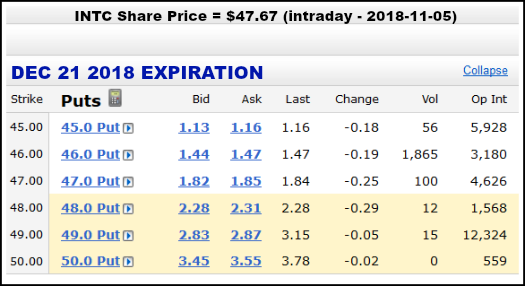
The above is from TDAmeritrade.
Every broker and website that publishes option quotes will have their own unique look to their option chains, but they all contain the same core information:
The above is also just a snapshot.
A full chain would include multiple expiration cycles along with quotes for both calls and puts.
And each option expiration cycle will have many more strike prices available than what's included above (these are "at or near the money" - meaning these are strikes that are closest to the current share price of the underlying stock).
So let's say that you don't believe that INTC will trade lower in the near term, OR that you would potentially like to acquire shares at a little lower price than where they are currently trading.
(Again, we'll go into more detail in Chapter 2 about selling puts for income vs. selling puts for stock discounts).
So you decide to sell or write an INTC DEC 21 2017 $47 PUT for $1.82/contract.
A few points to make sure we're on the same page:
#1 You sell options at the bid price (e.g. SELL TO OPEN a new position or you SELL TO CLOSE an existing position).
#2 You buy options at the ask price (e.g. BUY TO OPEN a new position or BUY TO CLOSE an existing position).
#3 Always submit your orders as limit orders and try to get better pricing than what's quoted on the option chain when it makes sense.
With the INTC example, the bid-ask spread is actually pretty narrow ($1.82-$1.85), so if I were selling the $47 put, I would simply enter the order as a SELL TO OPEN limit order specifically at the $1.82/contract bid price.
In other situations, the bid-ask spread on an option you want to trade may be a lot wider.
If, for example, the bid-ask quote was $1.80-$2.00, then I would submit my Sell to Open order for $1.85/contract and there's a good chance I'll get filled at that price (or better, depending on your broker).
#4 With a SELL TO OPEN short put trade @ $1.82/contract INTC example, you receive $182 in cash after your order is filled.
Minus commissions, of course - and that will vary according to your broker.
Commissions do add up.
Depending on how much you trade, going with an online broker with extremely low commissions (such as Tastyworks or Interactive Brokers) can literally save you - or boost your returns by - hundreds of dollars per month.
Chapter 2 - Selling Puts for Income vs. Selling Puts to Buy Stock at a Discount
Any time the topic of selling puts comes up, you're almost always guaranteed to hear someone say something along the lines of:
"Only sell puts on stocks you don't mind owning."
Please. What does that even mean? That's like saying you should only sleep with people you don't mind marrying.
Huh?
How does that improve your dating life OR your prospects of finding a soul mate?
The first piece of put selling advice you should take to heart is this:
Know exactly why it is you're selling puts in the first place.
And there are only two viable reasons . . .
Reason #1 - Selling Puts for Income
As we've already discussed, selling or writing puts is often compared to being your own miniature insurance company.
But instead of insuring someone else's car or house or life, you're insuring the share price of their stocks.
If the stock in question cooperates, you can make some very good short term returns.
And this has nothing to do with owning the shares.

When Allstate or State Farm or Geico insures your car, it's not a clever ploy on their part to gain possession of your vehicle at a less than fair market value.
They're simply trying to turn a profit.
If you're primarily drawn to put selling because of the great short term income the strategy can produce, don't feel guilty about that.
And you don't have to limit your put selling "clients" to only those stocks that you think others would approve of as suitable long term investments
At the same time, since it is about making money, quality does come into play, as does a number of other factors that you want to line up in your favor as much as possible (which we'll look at in Chapter 3).
And inside the Leveraged Investing Club - specifically, in the training included in the Sleep at Night High Yield Option Income Course - we take things a step (or three?) further.
The Course and Club (when periodically available), don't just show you how to sell puts as though you were a generic insurance company.
Not in the least.
I show you how to transform yourself into "The Insurance Company from Hell" where your objective is to collect lots of premium and then avoid like the plague ever paying out a claim.
(Which I define as either buying back your short puts for a loss or allowing yourself to be assigned the shares against your will.)
When you have the necessary clarity, you discover that selling puts is not just a forgiving strategy - it's amazingly flexible one that allows you to repeatedly "renegotiate" the insurance policies you write to your advantage
As many times as it takes.
There are no guarantees about anything in life, but it's extremely rare that we ever book a loss at the end of the day selling puts.
I call it Heads You Win, Tails Mr. Market Loses, and we'll look more closely at managing and repairing short put trades in Chapter 6).
So there's no shame in selling puts for current, high yield income - and with no intention or willingness on your part of ever owning the underlying shares.
But if you do like the idea of outsmarting Mr. Market and acquiring shares of a stock at a steep discount, put selling can be a powerful way to do just that.
Reason #2 - Selling Puts to Buy Stocks at a Discount
First, a disclaimer - I'm not talking about generic put selling here.
Selling puts to acquire stock at a discount is often explained in a very basic, very superficial way - which, at best, results in small, one time discounts.
This Investment U article is pretty representative of that superficial approach.
Basically, this standard, wishy-washy approach involves writing or selling an out of the money put (i.e. at a strike price below the current share price and "at a price at which you don't mind owning the stock").
>> If the stock is trading at or above the strike price of your short put at expiration, the put expires worthless and the cash premium you received when entering the trade is yours free and clear.
>> And if the stock is trading below the strike price at expiration, you will be obligated to buy the shares at the agreed upon strike price.
But your effective cost basis on those shares is calculated by taking your purchase price at the strike price less the initial premium you collected.
Say you sell a $30 put (i.e. at the $30 strike price) on a stock for $0.50/contract (or $50 total since each contract represents 100 shares of the underlying stock).
If assigned (and excluding commissions), your cost basis on the shares would be $29.50/share:
- $30/share times 100 shares = $3000
- $3000 less the $50 option premium you collected = $2950 net purchase price
- $2950 net purchase divided by 100 shares = $29.50/share adjusted cost basis
Presto, a small one time discount.
So What's the Problem?!?
Actually there are three problems with this overly simplified put selling approach.
>> First, by selling at out of the money put, you're collecting a relatively minor amount of premium.
The farther away the strike price is from the current share price, the less time value is included in an option's value, and at the end of the day, as an option seller, what you're really selling is time value.
(Time until expiration is another factor, of course - here's an important 3 part series on Best Durations When Buying and Selling Options.)
>> Second, the potential "discount" on an out of the money short put is often overstated because it's frequently calculated based on where the stock was trading at the time you entered the trade.
So if you sell a $30 put when the stock is trading @ $35/share and you end up with a $29.50/share adjusted cost basis, that's an impressive discount, right?
Actually, it's not.
Because whatever "discount" you generate is coming mostly from the decline of the share price - not the premium you collect and deduct from the strike price paid on assignment.
And if the stock is trading a lot below $30/share (which is what triggered the assignment) then your "discounted" $29.50 adjusted cost basis is likely going to be a lot higher compared to stock-only investors who bought shares after the stock dropped.
>> And third - what drives me battiest about these superficial explanations is the brain dead assumption that these short put trades have to be one time, binary events.
They're not in the least, and as we'll see in Chapter 6 on trade management and repair, the ability to switch from a single trade mindset to a campaign mindset will put you miles ahead of the generic traders.
But the way this approach is almost always dumbed down and illustrated, it's a one shot trade from a very small caliber weapon.
How to Get Big Discounts on a Stock When Selling Puts
OK - if selling puts simplistically for small, one time discounts doesn't cut it, then what does?
How do you go about using the strategy to get legitimately big discounts on your favorite stocks?
It's a simple mind shift where you go from viewing these as one time trades, and thinking of them instead as a potential campaign or series of trades.
(When selling puts for income, the majority of your trades likely will be one time trades, but if you're truly seeking to buy stock at big discounts, the campaign mindset is essential.)
Collecting Premium Multiple Times on the Same Trade
With a put selling campaign, it's still a single trade in a way. It's just that the trade has multiple points (or legs) that repeatedly bring in additional premium.
We'll look at rolling and adjusting your short put trades more in depth in Chapter 6 on Put Selling Trade Management and Repair.
But the ability to roll a short option position for a net credit - i.e. to collect more in new premium for setting up a new trade at a later date than what it costs you to buy back or exit your old, expiring position - is arguably the most important advantage you have as an option seller.
Let me show you what I'm talking about . . .
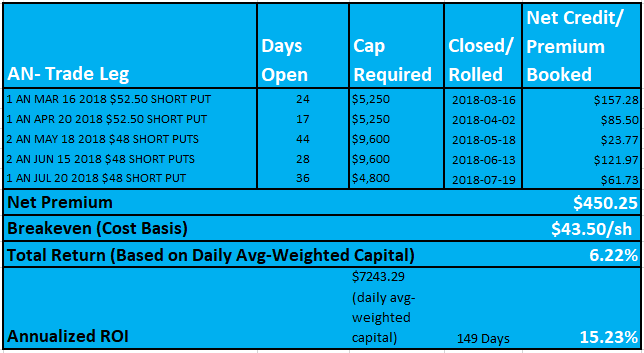
Below is a Trade Performance Table on an AutoNation (AN) naked put campaign I traded inside the Leveraged Investing Club during the spring and summer of 2018.
Now, on a literal basis, this campaign was not about selling puts in order to buy stock at a big discount.
It was about selling puts for income - and then managing and repairing a trade that went against me when the stock traded (a lot) lower so that I still ended up booking damn good returns at the end of the day.
The ability to make good returns on bad trades is what I love more than anything else about selling puts - which we'll look at more in Chapter 6.
But the same "campaign" principle would've applied had my goal been to acquire AN at a steep discount.
- LEG #1 - The first leg of the campaign - in which I sold or wrote a single AutoNation MARCH 16 2018 PUT at the $52.50 STRIKE PRICE - brought in $157.28 in premium after commissions
- LEG #2 - On March 16th, I rolled the $52.50 short put out one month to the APRIL 20 2018 Expiration Date for a $0.94/contract net credit, or $85.50 in additional net premium after commissions (i.e. with the stock trading @ $50.67/share, I paid $1.86/contract to buy back my expiring MARCH $52.50 short put but collected $2.80/contract for selling the new APRIL $52.50 put)
- LEG #3 - AN continued trading lower, and on April 2nd, with the stock down to $45.48/share, I rolled and adjusted the position for a smaller $23.77 net credit (I bought back my APRIL 20 2018 $52.50 SHORT PUT for $7.10/contract and then sold TWO MAY 18 2018 PUTS at the $48 STRIKE for $3.80/contract, or $760 total before commissions)
- LEG #4 - On May 18th, with the stock trading a little higher ($46.39/share), I conducted another straight roll out one month, to the JUNE 15 2018 expiration date, for another $121.97 in new net premium, or $0.66/contract net credit times 2 contracts (buying back the MAY $48 PUTS for $1.66/contract and selling TWO JUNE 15 2018 $48 PUTS @ $2.32/contract)
- LEG #5 - The final leg of the campaign involved one more roll/adjustment on June 13th when the stock had rebounded some to $48.40 - this time I rolled the position out one more month and reduced the contracts from two back down to one and still collected a $61.73 overall net credit on the new leg (buying back TWO JUNE $48 PUTS @ $0.35/contract and selling a single JULY 20 2018 $48 PUT for $1.46/contract and then, one day before expiration, with the stock trading @ $49.41/share, I exited the trade by buying back the JULY $48 SHORT PUT for $0.05/contract)
Whew!
Those are a LOT of numbers, I know.
Here's the important takeaway:
By conducting rolls and adjustments, I was able to collect and book an accumulated $450.25 in total premium - meaning my theoretical cost basis (assuming assignment at the $48 final leg strike price) would've been all the way down to $43.50/share.
Now that's a freaking discount!
Smarter Ways to Buy Stock at a Discount When Selling Puts
But if you keep rolling and adjusting and managing an in the money position until it's out of the money and you're no longer at risk of assignment, how do you ever acquire your shares at the big discount?
Because, as you can see, at the time I exited the trade, the position was comfortably out of the money (the $49.41/share price of the stock was well above the $48 short put strike price one day before that put was set to expire).
Again, the purpose of this trade was for the income, not the stock discount.
Had I really wanted to acquire AN stock at a serious discount, I had multiple ways of doing that:
Technique #1 - Allow Assignment
At any point when the short put position was in the money (i.e. the share price trading below the put's strike price), I could've allowed assignment at expiration by NOT rolling or adjusting.
But isn't that falling into the same trap I referenced earlier, namely that the "discount" comes mostly from the falling share price?
Not necessarily.
It depends on how much total net premium I've collected and how much in the money the position is when allowing assignment.
If I had brought in $450 of total net premium over the life of the campaign and the stock was trading just a shade under the $48 strike price at the final expiration, then that really is a significant discount.
Remember, in theory, you can keep this process going for as long as you like.
And the more net premium you accumulate over time, the bigger your adjusted cost basis discount will be when you do allow assignment.
Practically speaking, however, there are reasons why you wouldn't want to keep the process going indefinitely.
If the stock began trending higher, I wouldn't recommend chasing the stock by rolling your short put(s) out and up to higher strikes, which could cause your breakeven/cost basis to actually move higher, not lower.
Technique #2 - Buy Shares on the Open Market
Who says you have to be assigned in order to buy a stock at a major discount?
A far more effective technique - and one that puts you in the driver's seat - is to manage your trades so that you don't get assigned, and then at the point of your choosing, make your own open market purchase of the stock.
At the time I exited the AN trade, the stock was trading @ $49.41/share, and there was nothing to stop me from simply buying 100 shares on the open market for $4941.00 before commissions.
Factoring in the $450.25 of accumulated net premium, that would give me an effective cost basis of $44.91, or a $4.50/share (or 9.11%) discount to the then current share price.
And if you want to get even more creative, who says you have to buy 100 shares? It's an open market purchase, so you can buy however many shares you want.
For example, what if I had chosen to buy 50 shares on the open market upon exiting my short put trade?
>> Before commissions, 50 shares of AN times $49.41/share = a $2470.50 open market purchase price.
>> Factoring in or deducting my $450.25 of accumulated net premium brings my net purchase price down to $2020.25, or about $40.41/share, or a $9/share (or 18.23%) discount to the current share price!
Technique #3 - Pausing a Campaign
Here's something else to think about.
Who says your put selling campaign to buy stock at a big discount has to be uninterrupted?
If you're selling puts on the stock you want to acquire for a big discount, and that stock is already trading in value territory, and then suddenly it's not, you can simply pause your campaign.
As I mentioned earlier, in my view it's not a good idea to chase a stock higher by selling puts at higher and higher strike prices (especially if you want to buy that stock at a discount).
If or when the stock pulls back again, then it's simply a matter of resuming that campaign by selling new puts on the stock.
Here's a good - if extreme - example:
Back in the 2014-2016 period I had a very long running short put trade on ANF (Abercrombie & Fitch).
Again, as with the AN trade, this was about selling puts for income not discounts, but the same principles apply.
The campaign ended up being a 487 day trade that netted me 30.66% total returns (or 22.98% on an annualized basis):
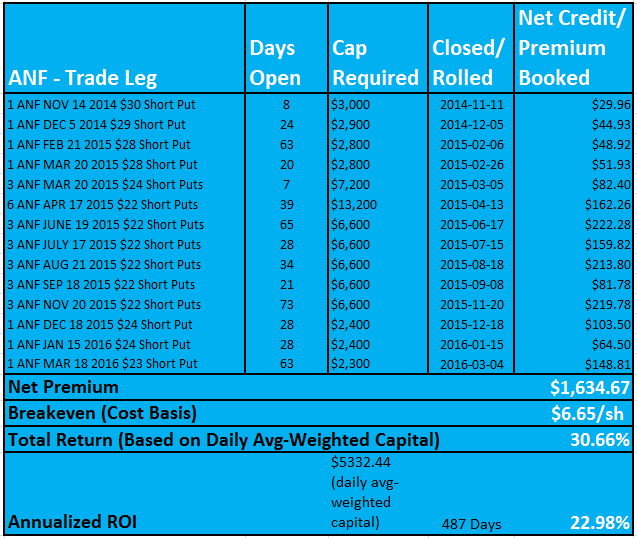
Same story as with the AutoNation short put campaign - each roll or adjustment involved collecting a net credit, or receiving more for selling the new put(s) than what it cost me to buy back or close the previous put(s).
And aggressively working the strike price lower in the process as the stock traded lower over time.
The returns on this "bad" trade were so good, I would've happily kept the trade going forever.
But eventually the stock made a big move higher and when I let the position go, the stock was trading above $32/share.
But guess what?
By 2018-05-26, ANF had tumbled again and was trading @ $20.89/share - at which point I sold a brand new ANF AUG 19 2016 $20 PUT.
That brought in another $129.50 of premium after commissions. The stock closed at expiration trading @ $22.55 and I allowed my $20 short put to expire worthless.
Now, I didn't include this leg in the main trade campaign table above, but I certainly could have - and that would've lowered my potential cost basis even more.
My point here is that if you're going to apply the proceeds of a put selling campaing to the eventual open market purchase of a specific stock, there's no rule that says your campaign can't take a break from selling puts on that stock when it makes sense to do so.
Technique #4 - Think in Terms of Your Overall Portfolio
Finally, after you've transitioned from a single trade mindset to a campaign mindset, there's one more profound mind shift available to you if you're serious about buying stocks at the biggest discounts possible.
And that's when you make the shift from specific campaign to viewing your entire portfolio as a discounting and funding machine.
What exactly does that mean, and how does it help?
Well, let's go back to our insurance company analogy.
Insurance companies have a pretty sweet deal.
They take in premium upfront, hold on to massive amounts of cash and then only later, pay out a portion of that premium in the form of claims.
In the meantime, all that cash they hold (called the "float") is investible.
Most insurance companies invest their float in fixed income, so in higher interest rate environments, these companies can earn more from their investments than from their own operational earnings.
Warren Buffett took this model to another level with Berkshire-Hathaway.
In the early days, Berkshire had a heavy concentration of insurance operations (and obviously still does a lot of insurance business).
But instead of parking the float and operational earnings into fixed income, Buffett plowed the money into attractively priced, high quality, and high cash flow businesses and their stocks.
And that gave him both income in the form of dividends along with the potential for a great deal of capital appreciation (which, of course, is exactly how things played out.)
Buffett's success has come from his ability to reinvest, on a large scale, high cash flow opportunities into additional high cash flow opportunities.
The perfect recipe for creating the world's largest snowball.

(Source: Guinness World Records)
My premise is that you and I can do the same thing.
We can sell puts to achieve the same results - generating high cash flow from multiple low-risk, insurance-like option trades and then reinvesting those proceeds into shares of attractively priced high quality companies.
And not just the stocks we sold our puts on.
Example - Let's say your put selling operations are bringing in $1000 a month of income from multiple trades.
You can accumulate those funds and then re-invest them all at once into the open market purchase price of your favorite high quality stock when that stock is trading at an attractive valuation.
Even if you never sold a put on that stock.
So maybe after four months, you buy 100 shares of your favorite stock for $40/share - but because the funds to purchase those shares came from the proceeds of your various option selling trades from the previous four months, your cost basis on the shares would essentially be zero.
Or maybe you buy 200 shares and settle for a 50% discount on the stock.
There are two reasons why using the proceeds of put selling on Stock A to acquire shares of Stock B really is worth considering:
- It allows you to concentrate the power of your full portfolio into the acquisition of one stock at a time and thereby manufacture much larger discounts
- It's also crucial to recognize that a great investment may not make a great put selling trade
Just because a high quality stock makes a terrific long term investment, that doesn't mean it's always going to make a good put selling trade.
The stock's options may have low implied volatility levels, or they may be thinly traded, or the underlying nominal share price may be too high, or any other number of reasons.
And one of the hallmarks of our trading approach inside the Leveraged Investing Club, we start our short put trades with relatively small position sizes - whether we're selling puts for income or in order to buy stock at a discount.
- For the income route, small position sizes are much easier to manage and repair (which we'll cover in Chapter 6).
- And for the discount route, we still never want to be assigned the shares against our will - because we want to buy shares on our terms, not Mr. Market's, and the longer we're in a trade, the lower we work our cost basis.
Bottom line - trade management and trade repair is just as important if you selling puts to buy stock at a discount as it is if you're selling puts primarily to generate current high yield income.
Does Warren Buffett Sell Put Options?
Most investors don't realize this, but Warren Buffett has, through Berkshire-Hathaway, sold puts in a very big way - and both to buy stock at a discount as well as to generate investible income.
Check out this GuruFocus article for the full details, but the short version is that:
- Buffett and Berkshire sold 50,000 out of the money put contracts on Coca-Cola back in 1993 (collecting $7.5 million in premium)
- He also sold around 55,000 puts on the Burlington Northern Santa Fe railroad in 2008 before Berkshire eventually acquired the entire company
- And during the Financial Crisis of 2008-2009, he sold special equity index puts against the S&P 500, the FTSE 100, the Euro Stoxx 50, and the Nikkei 225 with expiration dates ranging from September 2019 through January 2028
Buffett's large short put trades on Coca-Cola (KO) and Burlington Northern (I think the stock ticker back then was BNI) was about buying shares at a discount.
The puts he subsequently sold on the four major indexes in the U.S. the U.K., Europe, and Japan are fascinating case studies in creative financing.
From selling these special puts (the counterparty wasn't other traders or market makers but rather some pretty big players such as Goldman Sachs), Berkshire-Hathaway collected $4.9 billion in premium which Buffett then reinvested.
I consider this a form of selling puts for income even though Buffett reinvested the proceeds - but sometimes the line between selling puts for income and selling puts to buy stock at a discount can blur.
Selling Puts to Buy Stock at a Discount - Conclusion
Small, one time discounts are better than nothing, of course, but the takeaway here is that you can do much better than that.
I used to do a Secret Seminar occasionally on a very simple, mechanical approach to manufacturing your own "Sweetheart Deals" on your favorite stocks.
It included a video and report.
I now offer that report for free on this page.
It's a good introduction to what's possible for long term investors with a more substantive understanding of writing or selling puts.
It's not exactly what we do inside The Leveraged Investing Club, but it's exponentially superior to the superficial way the strategy is almost always explained and employed.
My point is this: You don't have to settle for small, one time discounts, and you don't have to settle for the "wisdom" of the herd.
Once you free yourself from the oversimplified, generic descriptions of put selling, you begin to understand the incredible flexibility and potential of the strategy.

Chapter 3 - The Best Stocks for Selling Puts
We're going to look at specific set up criteria to use when looking for great put selling trades in Chapter 4.
But before we get to that, we need to step back and consider - in general terms - the kind of stocks that are best suited for selling puts on.
Said another way, this chapter is about the best stocks at a structural level for selling puts, and Chapter 4 is about the best conditions for timing your trade entries.
And we'll break down our exploration of the best put selling stocks into the following categories:
- Logistical Requirements for Selling Puts
- Sufficient Premium
- High Quality Businesses vs. Profitable Businesses
- Selling Puts on Value Stocks vs. Selling Puts on Growth Stocks
#1 - Logistical Requirements for Selling Puts
Not all stocks are optionable (i.e. have options that you can trade), and not all optionable stocks are suitable for selling puts.
In fact, it might be more helpful to identify the factors and components that exclude a stock from being a good trading candidate.
Not only will that help clarify what does, in fact, make a suitable potential candidate, it underscores an important point I've come to believe:
When the conditions are right, and assuming you follow some important set up criteria, the pool of potential trade ideas is very large indeed and there is no shortage of good trades out there.
Yes and no.
Beginning mid-year 2018, inside the Leveraged Investing Club, we also began incorporating small, conservative bear call spreads on stocks we felt were unlikely trade higher in the near term.
We'll have a lot more to say about Limited Downside Situations for selling puts in Chapter 4, but you'll have maximum flexibility if you can also flip the switch as it were and benefit from stocks that are in the process of topping out and turning over (by selling calls) vs. only benefiting from stocks that are bottoming out and rebounding (by selling puts).
We try to enter one new trade a week (with initial target durations that are generally in the 3 week to 45 day range, although when the trade really works out, we'll often be able to exit way ahead of schedule and lock in most of the trade's max potential gains in an abbreviated holding period) - but we now go with whatever the best set up is.
Some weeks that's going to be selling a put.
Other weeks, that's going to be setting up a small, conservative bear call spread.
My point is that finding great trade ideas - whether you sell both puts and calls as conditions warrant, or whether you only sell puts - is rarely an issue.
Yes, you really can still find attractive put selling trades even in a bear market (more on that in Chapter 6).
Types of Stocks to Avoid Selling Puts On
At the most basic level, you want to avoid selling puts on any stock where the options are structurally unattractive.
What I mean by that is a situation where the options in question don't provide very good choices or terms.
This is almost always a result of the options themselves being thinly traded - that's the common denominator.
When that's the case, you'll frequently find any or all of these less than ideal components:
- Strikes Priced in Wide Increments
- Wide Bid-Ask Quotes
- Limited Number of Expiration Cycles
Let's look at an example - simply at a structural level - that would be a bad stock to sell puts on:
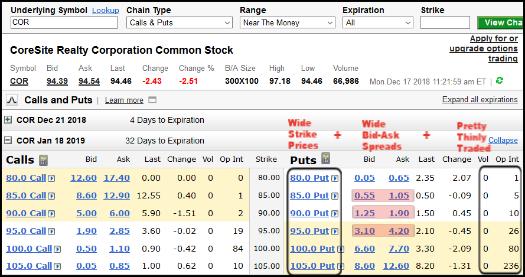
You can see it for yourself - the strikes are priced in $5/increments, the bid-ask spreads are ridiculously wide, and there's very little option trading volume.
What that means is poor and inefficient pricing for option traders.
True, you should always submit your option orders as limit orders, and unless the bid-ask spreads are particularly tight, try to get better pricing the quoted prices.
But when you see really wide prices like this, it's going to be challenging to get a decent price.
And once you're in a trade, you're totally at the mercy of the market makers if you want to exit a successful trade early or roll or adjust an existing position.
The big $5/contract increments between the strikes can also be a problem. The fewer strike prices that are available, the less precise you can be setting up your trades.
And finally, although you can't tell from the option chain above, in our COR example here, there are a very limited number of expiration cycles available - in this case, the December 2018 monthly options expiring in only a few days, January 2019, February 2019, and May 2019.
And that's it.
That may not be an issue when setting up your trade, but it can be an issue during the trade management process if you need to roll your position (we'll cover put selling trade management in Chapter 6).
Now, I don't advocate rolling a position ridiculously far out in time, but again, as with the limited number of strike prices, the fewer choices you have, the less flexibility and efficiency you'll have managing your trades.
Best Stocks for Selling Puts
In contrast, let's look at an example of a stock with the complete opposite characteristics:
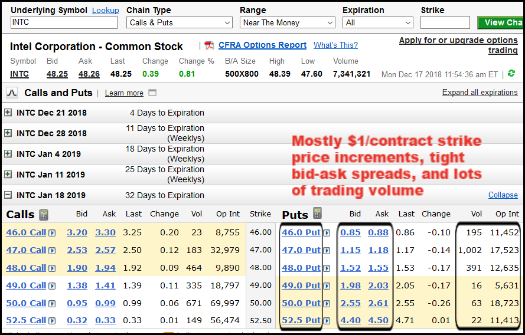
As you can see here with INTC (which we've traded on multiple occasions inside the Leveraged Investing Club), this is a very trading friendly security:
- The strikes on the monthlies are priced in nice, friendly $1/increments (the weeklies are even better as they're price in $0.50/contract increments)
- the bid-ask spreads are very tight
- And as you can see, INTC options get traded a lot
- Finally, what you can't necessarily see is that, in addition to trading weekly options, INTC options include expirations that go out for 2+ years
Put all that together and it spells a structurally favorable stock on which to sell puts - when specific set up conditions warrant, of course (which is what we're going to discuss next).
#2 - Sufficient Premium
When selling puts, it's a lot like the story of Goldilocks and the Three Bears.
If you sell puts with super high premium levels, that's a good indication that you've entered a high risk trade.
But you don't want to sell puts where the implied volatility pricing is too low because that can also be risky in its own way.
That's because the premium you collect upfront has a direct impact on how much of a downside buffer your trade initially has.
The more premium you receive when selling a put, the lower your initial breakeven or cost basis will be.
And it can also be more challenging to manage or repair trades with lower implied volatility levels for the same reason - there's not enough new time value available for effective rolls and adjustments.
(Don't worry - we'll cover these concepts in more detail in Chapter 6.)
Calculating Implied Volatility
The premium available when selling an option is a direct result of how volatile Mr. Market expects the underlying stock to trade during the life of the option in question.
You can usually find an option's implied volatility figure - represented as an annualized percentage move in the underlying stock - on an expanded option chain.
The implied volatility figure tells you the annualized share price range of the underlying stock over the option's holding period.
Project Option has a really good article explaining implied volatility.
While I don't specifically use the implied volatility figure to set up or manage trades (I use the annualized return metric which I'll explain in a sec), I've found in general that selling options with implied volatility percentages in the mid-teens or lower is usually a deal breaker.
Conversely, when selling options with implied volatility levels in the 30s or higher, be aware that the underling stock is likely going to be moving around quite a bit.
A Better Way to Ensure You're Selling the Appropriate Amount of Time Value
I personally use the annualized metric when setting up a short put trade.
There are similarities with the implied volatility calculation, but I find the annualized figure is easier to work with (because I can calculate it myself) and it makes a lot of sense.
I basically take the premium available and calculate what my annualized returns would be on a cash-secured basis assuming the trade is held to expiration and that your short put expires worthless.
For me, I've found that targeting 15-25% annualized returns on new trades balances things out very nicely - it ensures I'm getting sufficient compensation for my put selling services while keeping me grounded and away from higher risk setups.
For more information on how and why to trade and manage trades with the annualized metric, check out this site article.
#3 - High Quality Businesses vs. Profitable Businesses
I use to be a real stickler for only selling puts on the highest quality businesses I could identify.
That was especially true during the Financial Crisis fallout and Great Recession. I only wanted to work with stocks where the underlying business could survive Armageddon, because that's nearly where we found ourselves.
And in the several years that followed, selling puts on high quality stocks was the gift that kept giving - implied volatility levels were very good even on world class consumer staple type companies.
But eventually those opportunities became less and less so that simply selling puts on stocks like KO and PG no longer paid that well except under very specific situations.
At the same time, our trade selection, management, and repair processes have become so much more effective (and efficient with our capital), and as I actually tested my biases in the real world, I found that when the valuation and technicals were on our side, all we really needed was a profitable business.
While we may not be able to pinpoint it ahead of time - there will ALWAYS be a point below which Mr. Market simply cannot push the stock of a profitable business any lower.
Bottom line - there's a limit to how low Mr. Market can sink the shares of a still profitable business, but there is no such limit to how low I can reduce the breakeven/cost basis on my trade
Again, we'll talk more about how to manage and, if necessary, repair put selling trades that move against you in Chapter 6.
But a good way to think of a "bad" put selling trade is that while Mr. Market can sprint faster than we can, we have much greater stamina and can cover more ground than he can over time.
There may be uncertainty as to how low a stock will go before finally bottoming (but even the most hated stocks of profitable businesses will eventually find a floor, and the returns on our "bad" trades aren't going to be anywhere near our "good" trades, but as long as we don't sabotage our trades, I firmly believe that never losing money in the stock market is a legitimate objective.
In 2018, for example, we successfully sold puts on a number of questionable, beaten down, or just plain hated stocks like DISH, NWL, HBI, DHI, and SIG.
At the end of the day, it goes back to what we covered in Chapter 2 - Selling Puts for Income vs. Selling Puts to Buy Stock at a Discount.
If your primary objective is to acquire heavily discounted shares, then definitely choose high quality stocks when selling puts.
But if you're selling puts as a way to generate safe, high yield income, as long as you approach your trades in smart and sensible ways, know that there can still be great - and still low risk - opportunities on stocks that would be considered lower quality.
#4 - Selling Puts on Value Stocks vs. Selling Puts on Growth Stocks
Is it better to be prepared for a natural disaster, or to avoid living in an area prone to experiencing them in the first place?
That's an important question - and it's also one that, in a weird way, put sellers have to ask themselves as well.
Not literally, of course.
But as a put seller, you do have to make a similar choice - are you going to sell puts on value oriented stocks, or are you going to sell puts on growth type stocks?
I realize it's an oversimplification to divide the entire stock market into value stocks and growth stocks.
So take what might be considered arbitrary classifications with a grain of salt.
We're painting with a broad brush here in order to identify the principles involved, in order to understand at the structural level the implications of the choices available to us.
Avoid the Bad Moon Rising

Don't go around tonight
Well, it's bound to take your life
There's a bad moon on the rise
- Creedence Clearwater Revival
I'll cut right to the chase - I'm with John Fogerty on this one.
I prefer to avoid trouble altogether in the first place if at all possible.
I avoid selling puts on richly valued stocks, no matter how attractive I think the fundamentals or technicals are.
If there are any hiccups along the way, the repricing of a stock can be sudden and severe. And with an elevated share price, it can be a long way down.
I'm not criticizing anyone who sells puts on momentum stocks, because you really can make some big returns over time if everything works out.
But I know what works for me, and what my ultimate objective is - to make money on every trade I enter and to NEVER lose money.
Heads I Win, Tails Mr. Market Loses.
If you understand how to exploit them to their fullest, short puts can be very flexible and forgiving - but the less carnage you expose yourself to, the better.
Short puts - in the right hands - can handle stormy seas. But that doesn't mean you should seek out hurricanes for sport.
Even before I developed and perfected the super effective 4 Stage Short Put Trade Repair Formula, I used to jokingly say about selling puts that the first 30% decline in the stock was manageable.
It was that second 30% decline where things started to hurt.
The craziest (because is was also very lucrative) naked put repair job I've ever done was the Legendary ANF Trade.
This is where the stock dropped 49.94% (at its closing low) after I entered the position (yikes - and the stock had already fallen a lot even before I sold my first put).
But when the dust settled, I actually made actual gains of 30.66% total or 22.98% annualized on real cash-secured capital over 487 days.
(Believe me, with those kinds of returns, I tried to keep this trade going for as long as possible.)
In contrast, the $SPX was actually down -0.88% during the same time period (early November 2014 through early March 2016).
It's OK to be Wrong, but Much Better to be Right
So while we can repair just about anything Mr. Market throws at us, it's still in our best interest to be as disciplined and as careful trying to be "right" as much as possible because the returns are going to be that much better.
And while it's a sensational feeling knowing you can be wrong on a trade and almost ALWAYS still come out ahead, the trades where you were right to begin with obviously require virtually zero maintenance.
Case in point - I mentioned above that ANF had already fallen a lot before I ever entered the trade.
As much as the stock would fall further after I sold my first put, missing that first big leg down was a big help.
Had I sold ANF puts at the top, it would've been a much tougher trade and far less lucrative.
Anytime you sell puts at what turns out to be a top, you make trade repair that much more difficult.
And for me, trade repair - i.e. never losing money on a trade - is my highest priority.
Doesn't mean I'm right or that that's the only approach, of course.
There's also a widely used approach to option trading built on the model of being willing to accept smaller losses (at least one hopes they're smaller) while gunning for and theoretically maximizing returns on winning trades.

Ultimately, our objective really is to never lose money in the stock market.
Period.
And that's much easier to do when we're wrong about a value investing situation than it is if we're wrong about a richly valued, high growth, priced for perfection, momentum type stock.
When looking for great trade ideas, our primary focus is on identifying what I call Limited Downside Situations.
Ideally, we want to identify MULTIPLE reasons why a stock is unlikely to trade lower, or lower by much, in the near term.
And valuation is a key component of our considerations.
So how was I so wrong about ANF's downside then?
LOL - There was a bit of a misunderstanding with the Legendary ANF Trade.
It was originally designed to be a very short duration trade - basically in and out before the upcoming earnings release at the end of the month.
Now, years later, I still maintain that was a good call and that I rightly identified a strong technical support level that was unlikely to be violated prior to that upcoming earnings release.
But what I HADN'T anticipated was that the quarter had been SO bad that the company felt compelled to issue an earnings warning in advance.
Crap.
Technical Support? What technical support?
The stock dropped like a rock and then Mr. Market and I were off to the races.
We'll Take After, Thank You Very Much
So we're much more interested in opportunities where the air has already been let out of a stock and there's no longer much downside remaining.
Another side benefit of working with out of favor stocks is that their options tend to have much higher levels of premium.
They're more expensive - so we get paid more for selling them.
Again, one of the saving graces of the Legendary ANF Trade was that those options had such high levels of implied volatility priced into them that the trade was easier to manage as a result, even as it was pretty underwater for a while.
We do consider factors other than valuation, and we also incorporate basic technicals to help us get the timing right on our actual trade entries.
The important thing is that with our "Limited Downside Situation" value investing oriented approach to selling puts, we don't need the stock to go up.
We just need it to not go down.
And that makes our task immensely easier.
Here's the beauty of the Sleep at Night Strategy.
When selling puts, we're not specifically looking for stocks that we believe will trade higher, and we're not specifically looking for stocks that we believe will trade flat.
We're just looking for stocks that aren't likely to trade lower.
When we're right - by definition - we're going to end up with a lot of stocks that do, in fact, trade higher.
That's the best outcome of all because a naked or short put will lose value most rapidly (which we want, of course) when the underlying stock trades higher).
When that happens, we're often able to lock in a majority of a trade's maximum potential profits in an abbreviated time period - and then we're free to go out and repeat the process.
A potential problem with growth or momentum stocks is that momentum works both ways.
So when a momentum stock stops trading higher, there's a good chance it's going to reverse course and head lower rather than simply trade flat.
Check out this 3 year chart on CMG (click to enlarge), which had been a Wall Street darling for years and routinely traded at 40+ times forward earnings:
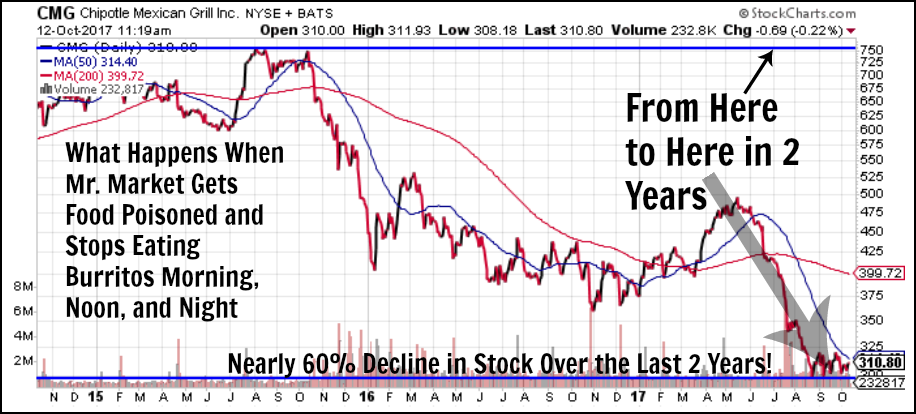
The stock would trade even lower - down to around the $250/share level by the end of 2017 and beginning of 2018. From around $750/share to around $250/share over roughly 2-1/2 years.
That's more than a double whammy - that's a double body blow:
- The stock loses two-thirds of its value
- It takes an insane 2-1/2 years to finally bottom
How long it takes a stock to bottom on those trades where we're wrong is critically important to the naked put repair process.
The longer the bottoming process takes, the longer you're going to be in a trade, of course, but the lower your final returns will also likely be on an annualized basis.
With the Legendary ANF Trade, for example, the trade was technically repaired within about 7 months (with somewhere around a 17% annualized ROI).
I chose to keep the trade going after then - and until the share price finally started moving higher again - in order to rack up the returns. The "post repair" part of the trade was producing annualized returns around 28%.
The Case for Selling Puts on Growth or Momentum Stocks
OK - all of the above is true, of course, but it's also arguably pretty one sided.
Yes, you're susceptible to experiencing some severe pain if you sell puts on a high growth stock at what ends up being a multi year high and then the bottom falls out of the stock.
But what makes a growth stock in the first place?
It's very simple - growth.
A stock that keeps trading higher and higher and higher. A stock that Mr. Market is in love with. A stock that value investors complain about year after year after year for being too expensive - and still the stock keeps powering higher.
As long as the premium levels are high, you can make a lot of money selling puts - and chasing higher - a stock that trends higher over a multi year run.
That CMG example?
From around $50/share to around $750/share by mid-2015, the CMG share price rose about 1400% with only one serious correction in 2012.
You don't get much easier money than selling puts on a stock like that.
So What's the Answer?
Like many aspects of option trading, at the end of the day, it comes down to being a personal choice.
As I've already explained, I sell puts from a value investing perspective rather than a momentum or growth stock perspective.
That's because my personal objective really is to never lose money on a naked put trade.
Seriously.
My concern then if I'm writing or selling puts on a momentum stock on what turns out to be the top is that my bag of tricks may not be sufficient to repair the situation.
Especially if, like with the CMG example, the underlying stock is going to shed two-thirds of its value, and take 2+ years doing it.
But you may not feel the same way.
You may feel the upside on stowing away via put selling onto a stock that rockets higher over a multi-year period is well worth the risk of that gravy train eventually coming to an end someday.
(And apologies for the atrociously mixed metaphor.)
If that's the case, the most important question is what can you do to limit or control the risks?
If you're going to live in tornado alley, or in a flood plain, or on the San Andreas fault, what can you do to better ensure your survival if or when that day of reckoning ever comes?
How to Make Selling Puts on Growth Stocks Safer
So if you're going to trade more aggressively by selling puts on growth or momentum stocks, how can you make that process just a little bit safe?
Just about any option strategy can be made to be more risky or less risky, and this is the case for put selling as well.
There are a number of factors to consider:
>> Small Position Sizes
Inside the Leveraged Investing Club, we initiate new option selling trades as "relatively small position sizes" (relative to the size of one's own account, or roughly one contract per trade on $50K accounts or smaller, somewhere around 8-12% of one's portfolio on larger accounts).
The same principle applies to selling puts on growth type stocks.
Yes, you're going to give up potential returns by scaling back the size of your trades, but you're also going to limit the damage Mr. Market can inflict on you if his feelings for the momentum stock in question ever sours.
This is also not a linear consideration.
If you've been successfully selling puts on a growth stock for a while, your capital - and capital requirements - have likely been increasing as well.
In other words, the amount of capital you have at risk is very likely to grow over time so that if/when the stock reverses course, the amount you have to lose has also compounded to a much higher figure than when you first started out.
>> Use the Bull Put Spread Structure
I tend not to set up very many bull put spreads and instead opt to simply go the naked put route.
It's important to recognize that there are two - very different, even mutually exclusive - purposes to setting up a bull put spread vs. a naked put (whether cash-secured or on margin):
- Leverage (bull puts require MUCH smaller capital amounts than do standalone short puts)
- Safety (adding an offsetting long put at a lower strike to your short put caps the maximum loss you can incur on your short put)
This is very important - you have to choose which way you're going to use credit spreads (whether bull puts or bear calls, which is the equivalent trade on a stock you expect to trade flat or lower).
Because you can't have it both ways.
You can't crank up your potential gains AND reduce your risks, and anyone who tells you otherwise either doesn't know what they're talking about, or, more likely, has an expensive credit spread service they're trying to sell you.
Red Flag Warning!
Look for those promoting a credit spread service to talk about return potential in terms of percentage, and losses in terms of total dollar amount per contract.
That's a very good indication that they do, in fact, recognize the risks of overleveraging credit spreads, but that they don't want you to.
What they say may be factually correct, but still extremely misleading.
The only way you get monster gains at a significant level is to expose larger portions of your portfolio to the very real risk of heavy, losses.
That's because credit spreads that cannot be converted back into their naked counterpart - because you traded too many contracts to do so - simply cannot be repaired in the same way that a naked option can.
If you think you're gong to get rich trading credit spreads - and that you'll be able to do so in a low risk manner - I would encourage you to check out this 4 part series on the pros and cons of credit spreads.
>> Incorporate Technical Analysis
Anytime you're selling puts for income rather than stock acquisition, I think you definitely need to incorporate at least basic technical analysis.
And that's true whether we're talking about being able to identify as early as possible when a growth stock's long term trend has broken down, or simply about improving the timing of trade entries, rolls, adjustments, exits, etc. in the near term.
And the good news is that, in my experience, you really don't need much more than basic technical analysis when selling puts.
>> Cutting Losses!
Yikes - it almost physically hurts to be typing this.
As my goal is to consistently make 15-25% a year selling options with virtually no individual trade losses (and in any and all market environments) the idea of willingly locking in a loss is, as they say, anathema.
But if you're going to be a put seller on growth and momentum stocks, losses are going to come with the territory.
You just want to make those inevitable losses as limited in scope as possible.
Are these losses really losses, though?
Because if you think about it, considering the larger picture and the total amount you've hopefully already booked when the party finally ends, you're not really booking a loss.
It's more like you're giving back some of the gains at the end of the night to help your host pay to clean up the place.
But in order to keep that final expense as small as possible, you have to be psychologically prepared for the end of the party and guard against denial.
You don't want to make the classic investing mistake that you sometimes see inexperienced investors make after a big run up in their stock.
The stock tops out, turns over, and then sells off. But instead of locking in their gains, the inexperienced investor holds on, thinking (and then wishing) the stock will "come back."
Often they end up losing money on what should have been (and once was) a big score.
Don't do that!
To Summarize . . .
As a put seller you have a choice to make - are you going to sell puts on value type stocks or on growth type stocks.
>> I personally find value oriented stocks a whole lot safer to insure than growth or momentum stocks (and when you sell puts, you're essentially insuring a stock).
>> There is a case for selling puts on growth stocks, however - the potential for much higher returns and under super easy conditions for as long as a stock's uptrend remains unbroken.
>> Finally, if you do choose to sell puts on a growth or momentum stock, I think you would be wise to consider setting up and managing your trades in ways designed to scale back some of the inherent risk - those include:
- Small position sizes
- Using a bull put spread structure (sensibly)
- Incorporating technical analysis
- A willingness to cut your losses (vs. automatically standing your ground and attempting to repair a trade if it goes south on you)

Chapter 4 - How to Find Great Put Selling Trade Ideas
In Chapter 3, we looked at the type of stocks that are appropriate for selling puts (and the type of stocks that aren't).
In this chapter we're going to look at the specific conditions that represent attractive setups.
This is exciting stuff because I'm not going to hold anything back here.
In this chapter, I'm going to show you precisely how I go about finding great put selling trades.
The Trifecta of Great Put Selling Trades
I periodically do a Secret Seminar series on the Trifecta of Great Put Selling Trades, or what goes in to finding great put selling trades.
Whether I'm selling puts for income or to buy a great business at a great price, I'm on the lookout for what I call Limited Downside Situations.
Limited Downside Situation: Ideally identifying multiple reasons why a stock is unlikely to trade lower, or lower by much, in the near term.
There can be any number of special situation factors that we can consider, but if I had to boil things down to their essence, there are three primary factors that make up the Sleep at Night Strategy (my highly customized put selling strategy) selection process:
>> Quality/Fundamentals
>> Valuation
>> Technicals
#1 - Let's Drill Down! (Quality/Fundamentals)
We touched on this in Chapter 3, but in a perfect world, we could just sell puts on KO, MCD, JNJ, and PG all day and get paid handsomely.
But quality on its own isn't enough.
The stocks of great businesses can become overvalued, and ugly technicals should scare you away from selling puts no matter how fantastic the underlying business is.
Interestingly, as the trade management and repair process I've developed (into what is now the highly efficient and effective 4 Stage Short Put Trade Repair Formula) has gotten better and better, I find that stringent quality standards are no longer required.
That is, as long as other crucial criteria are met.
In fact, I make the case in this site article that with our Sleep at Night approach, when we sell puts, it's less about insuring a stock at a certain price and more about insuring a stock against the ultimate risk - insolvency.
What that means in English, is that when we follow our other setup and management protocols, as long as the underlying business doesn't go bankrupt, we're probably going to be just fine.
So in terms of "quality" or the fundamentals, all we really require is confidence that the underlying business is going to remain profitable.
(As long as that happens, no matter how much Mr. Market hates on a stock, there's no way a stock will trade down to zero - and the 4 Stage Short Put Trade Repair Formula is so effective, that's the only assurance we need.)
#2 - Valuation - The Secret Safety Net
A few years ago, I really developed a much greater respect for the role that valuation plays in Limited Downside Situations.
Fundamentals and technicals tend to hog all the attention among traders and financial media alike, but I find that valuation can function as a secret but still very powerful safety net when it comes to selling puts.
I discovered this myself when selling puts here and there on stocks that would never be described as high quality - ANF, CAR, MS, UAL, KR, NWL, AN, HPE, MU, etc.
Not all these are bad companies in the least (the bullish case on MU, in particular, grew considerably a year or so later, but at the time it traded like it was in the doghouse. The common denominator on all of these was that I sold puts on these stocks when they were extremely cheap.
(MS and MU in particular were trading much, much lower back then.)
Again, continued profitability (even if those profits aren't terribly impressive) plus low valuation equals a powerful combination when selling puts.
But let's not forget the technicals.
#3 - The Dark Art of Basic Technical Analysis
Some caveats (and reassurances!) upfront as the subject of technical analysis can have some baggage associated with it:
- Nothing we do inside The Leveraged Investing Club involves hard core technical analysis
- I very much believe that technicals are NOT a crystal ball - they don't tell you what WILL happen but rather what's more likely to happen and what's less likely to happen
- We don't trade technicals in a vacuum, but it's often the first thing I look at because a bad technical setup is enough to immediately disqualify a trade
My Three Favorite "Technicals"
I also really believe in focusing on the "why" you're doing something or why something works.
That ensures that clarity is front and center.
So when it comes to selling puts inside the Leveraged Investing Club, our use of technical analysis is simply about answering the following questions:
- Where is the likely floor (or technical support) in a stock?
- Is the stock trading near that floor?
- Is the floor holding?
- Is it likely that the floor will continue holding?
Not all floors hold, of course, and even if a floor fails after you've entered a trade, it's not the end of the world.
(There will be other floors, and our trade management process allows us to, in effect, take the stairs and retrieve/rescue our trade that way.)
But the point is that we still want to be as disciplined as possible when first setting up a trade so that the technicals are on OUR side rather than on Mr. Market's.
(And if they're on neither side, we'll likely pass there as well since there are rarely a shortage of great ideas.)
As a reminder, this is all about identifying what we see as Limited Downside Situations.
And when it comes to the actual technicals, I'm basically just looking at three things:
>> Support and Resistance
>> The RSI (for identifying oversold conditions)
>> The MACD Histogram (for identifying successful tests of support + reversals)
Again, these three technical components are designed to answer our questions about the floor in a stock.
It's as simple and straightforward as that - no mysteriousness or mumbo-jumbo or other murkiness.
At its best - and most effective - technical analysis isn't about sorting through bird entrails in order to divine the future with eerie precision.
It's simply about holding our finger in the air to determine which way the wind is blowing.
So let's look at these one at a time . . .
#1 - SUPPORT AND RESISTANCE
This is the mainstay of technical analysis.
Support and resistance simply shows you - at a visual level - areas where a stock has previously found difficulty trading below (support) or above (resistance).
The assumption then is if these price levels proved problematic in the past, there's a good chance they're going to do so again in the future.
Another analogy that might be helpful is to think of support and resistance as checkpoints that a stock must pass through before continuing on its way.
Some checkpoints may be easier to get through, some may be more difficult, and some may simply be impossible at this point in time.
But once a level has been violated, it often serves as the opposite counterpart - meaning once a checkpoint as been passed through, it doesn't necessarily go away.
So old resistance, once overcome, can serve as a powerful new floor or support level, and vice versa.
If you're brand new to all this, Investopedia has a good introduction to support and resistance here.
(I'll go into more details - in the next issue? - of my two favorite charting websites - Finviz and StockCharts - both of which have free versions that you should be able to get by with.)
#2 - RSI (Relative Strength Indicator)
I love the RSI, which stands for Relative Strength Indicator.
It's an oscillator which measures momentum in a stock (either to the upside or to the downside) on a scale of 0 to 100.
Readings above 50 indicate increasing momentum or strength to the upside; below 50 indicate increasing downside momentum or weakness in the stock.
As you might expect, momentum traders find the RSI useful, but it has a secondary function that comes in very handy for option sellers.
Turns out that it's a great tool for identifying stocks that are technically oversold (readings below 30) or technically overbought (readings above 70).
Why is that important?
In general, extreme moves in a stock in the short term aren't sustainable over a longer period.
So when a stock makes an extreme move, it's similar to a rubber band being stretched to maximum capacity.
Something's got to give - and while a stock can trade flat for a while and resolve the oversold or overbought condition that way, it will often resolve the condition by reversing itself.
Either resolution is fine with us as put sellers.
If we're selling puts on an oversold stock, we really don't care if the stock trades flat or if it rebounds in some way. We just don't want it to trade lower.
(We do benefit more - or at least faster - if the underlying stock bounces since we're then able to exit the trade earlier and redeploy our capital ahead of schedule.)
This sounds interesting in theory, but it's much more powerful when you see it on a chart.
Just play around and check out the charts of random stocks on StockCharts or Finviz and you can see for yourself just how often an oversold condition corresponds to a near term bottom (or top) in the stock.
Oversold RSI readings on a stock can be a powerful tool in helping us find Limited Downside Situations.
I've also spent some time rummaging through the Leveraged Investing Club basement and found some charts from over the years where you can see examples of what I'm talking about.
(These charts aren't specifically about the RSI, but I've added some commentary below so you can see exactly what I'm talking about):
MET - Multiple Oversold Readings
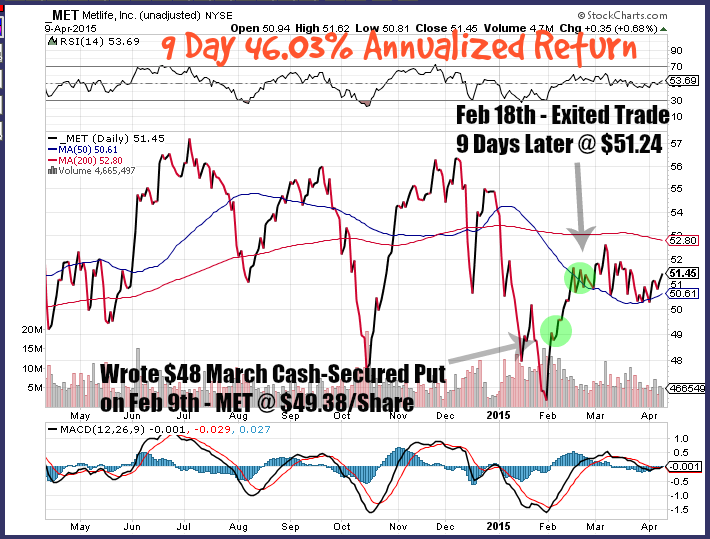
Check out the RSI reading at the top of the chart for October.
You can see that the RSI fell below 30 around mid October at the same time that MET registered a near term low.
And then over the next few weeks/months, the RSI fell to around 30 on multiple occasions which pretty consistently corresponded with other near term bottoms.
SIG - Oversold and Overbought Examples
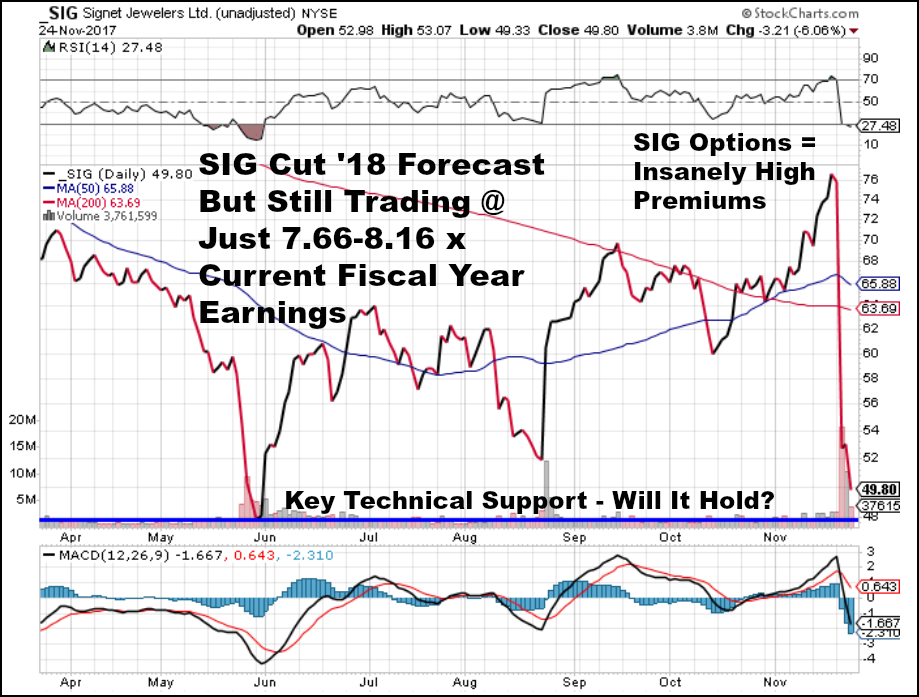
This chart is great because it contains multiple examples RSI oversold and overbought readings - and you can see for yourself how consistently they corresponded with near term bottoms and near term tops.
- Both oversold/bottoms @ end of May/beginning of June
- A near oversold/bottom in late August
- An overbought/top in mid September
- And another overbought/top in November just before a huge sell off
Also check out the earlier oversold reading in mid May and note how the oversold condition resolved itself not by a big or definitive move higher, but by a move that was more or less sideways (right before the stock sold off again and registered an even more oversold RSI reading).
It's important to be aware that an oversold or overbought condition can be resolved that way (trading flat) as well as by a reversal in the share price.
TROW - Multiple Examples of Both Oversold and Overbought RSI Readings
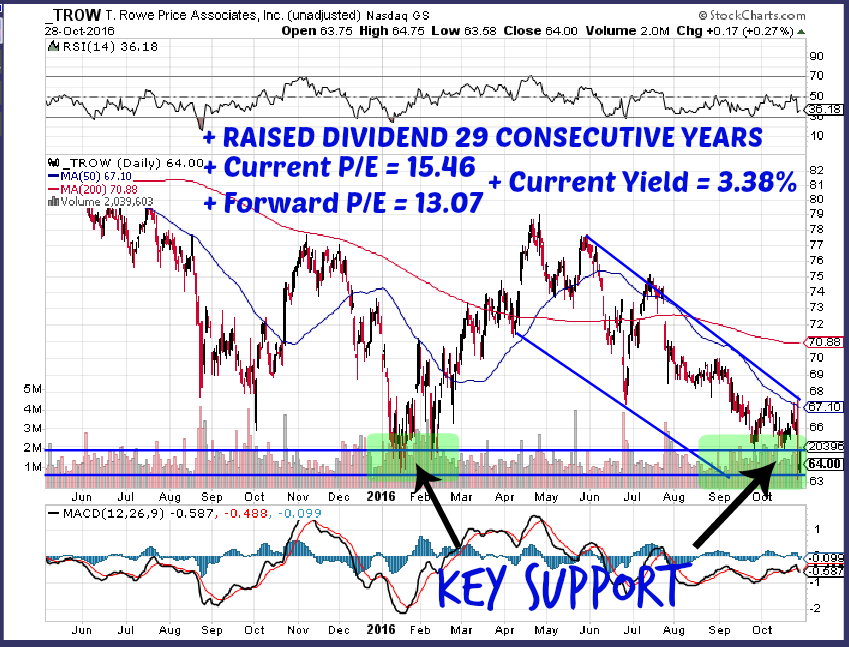
Here's a two year chart with numerous examples of oversold and overbought RSI readings.
I'll let you identify these and see for yourself how often these extreme readings corresponded with a near term top or bottom in the share price.
If you've never used, incorporated, or considered the RSI this way before, I really encourage you to study these examples - and consider reviewing more on your own.
Again, I love the RSI!
It's a simple and cool and very powerful little tool.
It's not completely foolproof, of course, as an oversold or overbought condition can persist for an extended period under extreme conditions or circumstances.
Or said another way, just because a stock is oversold, that's not a guarantee that it won't continue being oversold or trading lower for longer than you expect/hope.
Again, technical analysis isn't a crystal ball - it's a weather vane.
So the function of the RSI (as we use in inside the Club) is to let you know when the rubber band becomes very stretched and therefore some kind of reversion to the mean is more likely than not.
And when you can combine it with a key support level, you've most likely got a very nice short put setup.
That's because, when selling puts, we don't need the stock to go up - we just need it to stop going down. And an oversold RSI reading goes a long way to helping us identify these opportunities.
(Or vice versa, of course, if you're dealing with a Limited Upside Situation and looking to sell calls/conservative bear call spreads against a technically overbought stock.)
But that leads us to the next big question - how do you know WHEN to pull the trigger and actually enter a trade?
#3 - MACD Histogram
This is definitely one of my favorite indicators and - as you might expect by now - I prefer simplicity over complexity.
And this one really is fairly simple (even if it may not sound like it at first).
So if support and resistance tells us where the checkpoints are, and the RSI tells us when a stock may have moved too far, too fast, the MACD Histogram is a surprisingly effective timing tool to let us know when a stock may be reversing itself.
Now the first important thing to note is that the MACD Histogram is not the same as the MACD (or Moving Average Convergence/Divergence Oscillator).
The MACD Histogram are the bars behind the MACD lines.
Here's a StockCharts article that provides more info, but basically what the bars do is measure the distance between the MACD and its signal line.
Err . . . . you guessed it - So What?!?
At the risk of seriously oversimplifying, when the MACD Histogram bars are moving higher (i.e. getting smaller when below the zero or midpoint line or getting bigger when above the zero or midpoint line), the stock's positive momentum is increasing.
Now, fair warning . . .
I've been told by technical traders that the MACD Histogram doesn't quite do what I think it does - something about a tail wagging a dog - but you know what?
I don't care.
Whether it's cause and effect or rather just some kind of vague correlation, when I sell puts on a rising MACD Histogram and sell calls on a falling MACD Histogram, good things tend to happen.
Waves Lapping on the Shore - Or How About Some Examples?
As with the RSI, your best bet with the MACD Histogram is to just spend some time looking at charts of random stocks and see for yourself.
(I recommend you go with StockCharts on this one - the MACD Histogram is displayed larger there and is therefore easier to see.)
It's remarkable how often a change in the bars of the MACD Histogram correlate with an extended change in the direction of the stock (over the course of a few days to 2-3 weeks).
I talk about stocks zigging and zagging as part of their natural behavior, but perhaps a better analogy is that of waves lapping a shore.

What I specifically look for when selling puts is for the MACD Histogram to reverse course (from a decreasing or even flat trend) and begin to increase for 2-3 consecutive days.
(Remember, when the bars are below the zero or mid-point, the Histogram is increasing when the bars get smaller.)
Of course, it's much easier to see all this in chart form.
So let's look at some examples . . .
FAST - RISING MACD HISTOGRAM
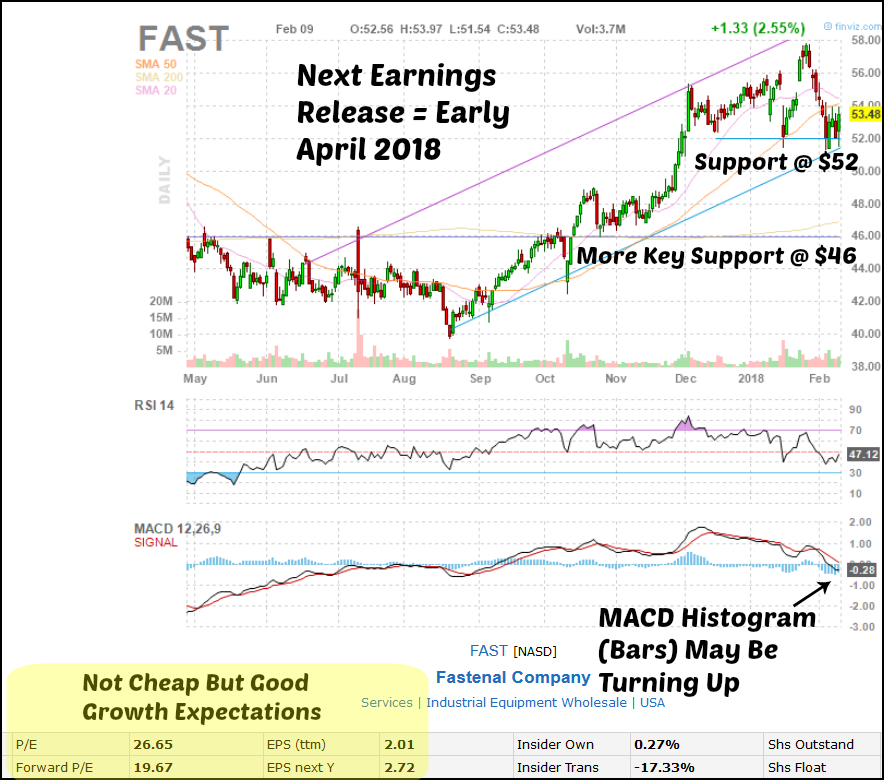
This is a chart I put together back in February 2018.
FAST had found support around the $52 area multiple times and then, as you can see, the MACD Histogram began moving higher and by mid-February, the stock was trading above $55/share, pulled back to $54, and then briefly traded above $56 by the end of the month.
This ended up being a 15 day trade for us inside the Club with an overall 51.68% annualized ROI.
PZZA - RISING MACD HISTOGRAM POST EARNINGS
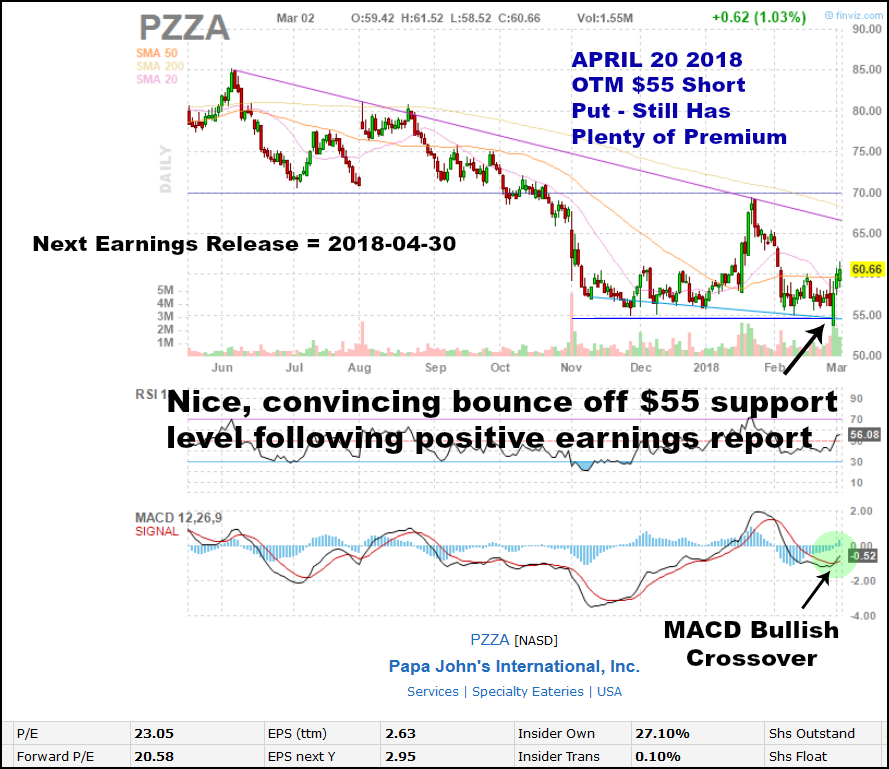
This was a fun stock to trade, and it always seemed to have a good amount of premium available on it (this was before all the ousted founder John Schnatter melodrama and controversy).
In this example, you can see that the MACD Histogram began turning up in early February 2018 and that PZZA subsequently traded relatively flat for the rest of the month, but we didn't enter the trade until later in order to avoid exposure to an earnings release.
The put selling trade still worked out for us as we sold a $55 put when the stock was @ $61.10 and exited the trade (by buying back the put) 32 days later when the stock was @ $62.59 (final booked annualized ROI was 22.93%)
CVS - TRIPLE THREAT (Cheap Valuation, Technically Oversold, Rising MACD Histogram)
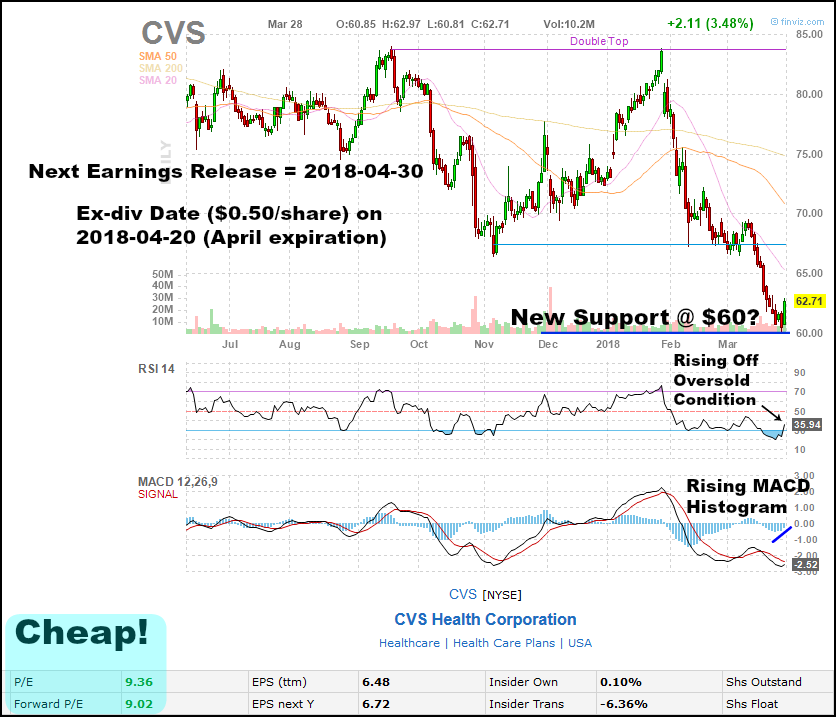
Fantastic example where everything converged nicely at the same time to make for an excellent put selling opportunity - cheap valuation, technically oversold stock, and rising MACD Histogram.
We sold a $60 put when the stock was @ $62.16 and exited the position 13 days later when the stock was trading @ $63.88 for a final 28.81% annualized ROI.
This is Powerful Stuff
You don't always get all three technical components to line up at the same time, of course.
Getting an oversold RSI reading is always a nice bonus, but these days I wouldn't sell a put on a stock with an oversold RSI until I also got the rising MACD Histogram confirmation.
But - truly - these are the specific tools (and the precise way in which I use them) to consistently find great put selling opportunities.
This really is actionable - and valuable - information I'm sharing with you, and there's no reason you can't begin using and benefiting from it yourself.

Chapter 5 - Best Position Size When
Selling Puts for Income
How Many Naked Put Contracts
Should You Sell to Open a Trade?
So what's the best position size when selling puts for income?
In this chapter of The Complete Guide to Selling Puts, I'm going to:
- Share the naked put position size guideline that works best for me
- Give my reasoning behind the guideline (it's for a different reason than you might suppose)
- Explain why I strive not to be too rigid about the initial set up size of my trades
- Discuss the important difference between principles and rules - and why principles are so much more powerful
- Include a couple of real world example to help illustrate what I'm talking about
Best Naked Put Position Size = "Relatively Small"

OK, drum roll . . .
In my opinion, the best position size when selling puts for income is one that's "relatively small."
Now, when I say that, a couple of thoughts probably occur to you:
#1 - It sounds pretty vague and wishy-washy
#2 - It's not exactly insightful since there's no one out there arguing that you should go out there and initiate large, concentrated trading positions
Fair enough, but let's dig a little deeper and take those criticisms one at a time.
First, Re: the vagueness, I would argue that's preferable to being overly rigid and rule based when it comes to position sizes.
I much prefer principles over rules, and once we understand the principles (i.e. how something works at the structural level) we're be in terrific shape to take things on a case by case basis and make informed choices. And that's the most powerful position to be in.
When we blindly follow someone else's rules, we often can't articulate exactly why the rules exist in the first place.
Rules are about trying to protect others when you don't have time to explain the principles. Or when the person you're trying to protect lacks the ability to process the principles.
Like telling a two year old to stay out of the street rather than attempting to teach the kiddo at that age how traffic actually works.
But we're not two year olds here. If you have any money to trade or invest, you're perfectly capable of understanding the specific principles involved in how to make more of it (and not lose what you already have).
Second, and related to the principles vs. rules dynamic, there's a huge difference between why I call for small position sizes and why conventional trading wisdom calls for small position sizes.
Conventional trading wisdom says to keep your positions small to protect yourself from large, portfolio wide losses.
There's a flaw in that reasoning, however.
Who cares if you have one position or twenty positions if all your positions are very similar (e.g. selling credit spreads on a whole lot of different stocks)?
If there's a large, market wide move, instead of having one big headache to deal with, now you have 20 smaller headaches to deal with (which amounts to the same thing at the portfolio level).
I argue for small position sizes because that makes the trade repair process that I've developed and customized a lot easier to implement.
On the surface, both are about risk control.
The conventional approach is about making sure one single trade doesn't blow up your entire portfolio.
The Leveraged Investing/Sleep at Night approach is about eliminating losses altogether and striving to make money on every single trade you enter.
Heads You Win, Tails Mr. Market Loses.
When Warren Buffett said Rule #1 is to never lose money, I took him at his word. I also learned to use options to tip the scales in my favor and make the task a lot easier to achieve.
The Principles Behind Relatively Small Initial Positions
Let's explore this a little more closely.
So there are actually two primary reasons behind or advantages of "relatively small" initial position sizes:
>> First, it ensures you give your portfolio some sensible diversification.
It's not just rules I don't like. I also don't like diversification just for diversification's sake.
As commonly advocated, not only am I skeptical that it makes you any safer, I think it's a recipe to dilute everything down into guaranteed mediocrity.
But if you're initiating new short put trades that are "relatively" small, that allows you the opportunity to trade across multiple sectors.
At the same time, you're not over-diversifying and having to keep track of so many trades that it feels like a job.
(And on a side note, another sensible use of diversification is to diversify through time - that's why once we get a portfolio going, we're only targeting adding one new trade a week.)
I would say, in general, that we typically have about 6-10 open trades at any given time - I feel that's plenty of diversification while at the same time still keeping the larger portfolio in the low maintenance category.)
>> Second, as I mentioned above, relatively small position sized short put trades are much easier to manage and repair in the event that something goes wrong with the trade.
Spoiler alert - no matter what strategy or approach you use, a certain number of trades or investments won't go according to plan.
That's why it's crucial that you only work with strategies that are repairable.
The Sleep at Night High Yield Option Income Course (available periodically) includes full training in my customized - and highly effective - 4 Stage Short Put Trade Repair Formula.
There are specific points in the trade repair process - under certain conditions and at specific times - where we will expend the size of our trade and actually add more short put contracts.
This can be amazingly effective in adjusting our strike price lower while still generating additional net premium.
At the same time, the 4 Stage Short Put Trade Repair Formula is designed to be capital efficient.
So if we start with larger positions, it would make this particular trade repair technique less effective because it would:
- Give us less bang for the buck
- Limit how many times we could employ it
(I'll show you some examples in a bit to illustrate how effective - and capital efficient - our highly developed trade repair process is.)
What is a Relatively Small Position Size When Selling Puts for Income?
OK - so what exactly is a "relatively small" position size?
Without any kind of frame of reference, we run the risk of this "principle" becoming arbitrary and being an excuse to set up any sized trade you want.
The first point I would make is that "relatively small" is in relation to the size of one's own portfolio.
For example, inside The Leveraged Investing Club, I demonstrate the Sleep at Night Strategy by managing a $50K portfolio (The Insurance Company from Hell Portfolio).
It's mostly cash-secured, but I do incorporate some margin on occasion.
I primarily teach the Strategy as cash-secured because that's the more conservative route and not everyone has access to margin.
But there can still be a sensible place for margin in a put selling portfolio - my mantra has always been "use margin to get yourself out of trouble, not into it."
OK - so with a $50K portfolio, in general, I'll initiate a new short put position with a single contract (if the strike price I'm working with is, say, less than $30-$40, I might start with 2 contracts).
Now, if I were running a $5 million portfolio, we would be talking about 100 contracts rather than 1 contract. Those would both be the same size trades relative to the size of the underlying portfolio.
Could we convert this into a percentage based rule?
Of course - probably something like 8-12% of one's capital for an initial trade.
>> But I would rather take things on a case by case basis and nor miss out on a potentially great trade because it would require that I exceed my self-imposed capital allocation rule by a small amount.
>> I also want to base my choices on a clear understanding of the underlying principles involved rather than relying on rules that I may be less clear about why they exist in the first place.
>> And, of course, I'm talking primarily about an opening or initial position.
If we reserve the right to potentially expand a trade - most of our trades work out as planned, of course, and never require this kind of intervention - then that means a small number of our trades may end up growing beyond our initial "relatively small" position size.
And that's OK.
That's just part of the trade repair process and nothing we've ever really had to worry about.
No matter how bad a trade goes for us, we can almost always repair it (and by "repair," I don't mean just avoid a loss - I mean that we still make money on the trade at the end of the day).
Traders with smaller accounts are often targeted by those who promote credit spread services because credit spreads (e.g. bull put spreads, bear call spreads, and iron condors) can be used to leverage positions with a whole lot less cash.
They may have a hard and fast rule about a maximum position size, and it very well may lull their subscribers into a false sense of security.
But at the end of the day, it's bullshit.
The harsh reality is that unless you can convert a credit spread back into its naked counterpart, you're overleveraged.
That's the ultimate sin of credit spreads - not the strategy itself, but the inherent overleveraging that most promoters and practitioners of credit spreads are guilty of (whether or not they even realize it).
And that's why credit spreads can be so difficult to repair if they blow up on you (as a certain percentage certainly will).
Heads We Win, Tails Mr. Market Loses means we don't employ strategies or enter a trade without the structure and tools available to successfully repair anything that goes wrong.
Because no matter how careful and disciplined you are when selecting a trade, you're never going to be 100% right about what a stock is going to do (or not going to do) within a specific time frame.
Examples - Best Position Size When Selling Puts for Income
Let's look at two real world examples:
- One where a small initial position size that was instrumental in helping to repair a seriously underwater naked put trade
- And one showing the opposite - where my position size was too large and I wasn't able to repair my short put position
The Legendary ANF Trade
The ultimate example in short put trade repair involved what I affectionally call my Legendary ANF Trade.
I originally sold a single $30 put on ANF (troubled teen clothing retailer Abercrombie & Fitch) back in November of 2014.
The stock had already come down a lot from its recent highs, it looked to me like there was very solid technical support in that $30 area, and I chose an expiration about a week and a half out ahead of an upcoming earnings release.
The thesis was sound - and to this day, I still believe it was sound.
Despite its problems, I felt ANF was unlikely to break that key technical support level absent some kind of catalyst (such as an earnings release).
So as long as I was in and out before that happened, it seemed a pretty low risk way to exploit ANF's elevated option premium levels.
But here's what I hadn't anticipated - the quarter was SO bad that management felt legally or morally obligated to issue a pre-earnings warning.
Catalyst created.
From there it was off to the races - Mr. Market kept pushing the shares lower and I kept adjusting and renegotiating the trade and working my strike price lower - and most importantly, generating net credits along the way.
Through a combination of what would become the Trade Repair Formula and ANF's elevated premium levels, what should've been a catastrophic loss turned into a trade that actually crushed the market during the same time period.
Seriously.
At its closing lows, ANF at one point had fallen 49.94% from my initial entry point.
When all was said and done, however, I generated 30.66% total returns on real cash-secured capital over 487 days (22.98% annualized) even as the S&P 500 was actually slightly negative during that same period.
This wasn't an issue of the trade being underwater until the very end when the stock miraculously recovered or spiked higher at some point.
I considered the trade to have been officially repaired much early - around the 6-7 month mark - but I chose to keep it going for as long as I could to further boost the returns.
But even at the point of repair, the annualized ROI on the trade was still something like 17.59% annualized.
OK - great story and a powerful confirmation of the profound effectiveness of the 4 Stage Short Put Trade Repair Formula, but let's go back to our larger point - small initial position sizes on our short put trades.
The fact that I opened this trade with a single contract at the $30 strike price (I was running a roughly $50K portfolio back then as well) meant that I had ample opportunity to potentially expand the trade if I needed to.
At its largest size, the ANF naked put campaign consisted of 6 contracts.
But keep in mind a couple of things:
- This was only briefly - just 39 days out of the entire 487 day holding period.
- And second, this expansion was at a much lower strike price than where I began the trade ($22 vs. $30).
I may have had six times as many short put contracts at one point than I started with, but from a cash-secured capital requirement basis, my maximum capital requirement was just $13,200, not $18,000 (6 contracts times the original $30 strike price).
A brief $13,200 capital requirement on a $50K portfolio is hardly high risk or strains the portfolio.
The Great AAPL Mishap of 2012
October 5, 2012.
This trade, in my personal account, started off innocently enough - it was supposed to be a one day trade on a weekly option where I expected to pocket an easy $133.46.
Very similar to the ANF trade in that regard - short term trade, easy money.
I wrote a single put on Apple at the $660 strike, meaning that I was basically offering to purchase 100 shares of APPL at $660/share if the stock closed below that price by the end of the day.
Unfortunately, the stock didn't hold, and I was forced to adjust the position.
And adjust it some more.
And then keep adjusting it again and again and again over the next 6 months as the shares kept falling.
I call this process "renegotiation" - and this is how, as I say, you can be "wrong" on a trade and still end up profitable - as long as there's a floor on the share price and as long as that floor isn't ridiculously far away.
To my credit, I eventually got the strike price (the price at which I was on the hook to purchase the shares) all the way down to the $440 level before I finally capitulated on the trade and took a $2900 loss.
Small consolation perhaps, but thanks to those "structural advantages" I keep talking about with these kind of trades, my loss was a hell of a lot smaller than a comparable stock-only investor who entered the position at the same time I did.
But still, the point is to not lose any money at all.
The point is to generate consistently good to great annualized returns without EVER taking a catastrophic loss.
($2900 may not be catastrophic, but still . . .)
My Biggest Mistake - Overleveraging
I made a number of mistakes on this trade - including not taking the technicals as seriously as I should have - but the biggest mistake involved my initial position size.
Yes, I went with a single contract, but this was way back in 2012, a couple years before the company did a 7:1 stock split, and the nominal share price was huge.
So, in effect, my initial trade size was seven times what it would've been had I entered a similar trade just a couple years later.
The problem here wasn't AAPL's business model - it was the fact that a single cash-secured put required $66,000 in cash.
So, in effect, when I initiated the trade, I was already in full expanded mode - I simply wasn't in a position to expand the size of the trade any more.
So from the moment I initiated the trade, I was without a perfectly good repair tool - the ability to expand the trade.
You can guess the problem - because the position wasn't remotely small relative to the capital I had available at the time, I was too overleveraged to be able to expand the position as part of the trade repair process.
I did what I could, of course, and put up a gallant fight, and even made significant process working the strike price lower.
But AAPL's correction proved to be deeper than my under-capitalized ability to weather it.
On a capital basis, I had no business entering the trade - even if it had worked out perfectly.
Chapter 6 - Managing, Adjusting, and Repairing Naked Puts
Being able to find great put selling trades, and knowing when and how to set them up, is only part of the battle, of course.
The next crucial component to your success as a put seller is knowing how to manage your trades.
In this section of Guide, we're going to cover managing, adjusting, and - if necessary - repairing your trades.
And the best way to do that is to separate our trades into two different groups - those that go according to plan, and those that don't.
Part 1 - Managing the Successful Put Selling Trade
What could be easier than managing a successful naked put position?
You sell a put on a stock and then then stock trades flat or higher.
As long as the share price doesn't dip below the strike price of your short put, you're good, correct?
Just let that baby ride and wait for it to expire worthless and then move on to the next trade, right?
Not necessarily.
In fact, there may be times when it makes a lot of sense to close a successful trade early.
And these situations usually fall into one of two categories (or often, as we'll see, both):
- Banking the bulk of your max potential gains in an abbreviated time frame
- The technicals suggest that the upside in the stock is now more limited than the downside
So let's take these one at a time . . .
Banking a Majority of Your Gains in an Abbreviated Time Frame
Inside the Leveraged Investing Club, we strive to manage our successful put selling trades by time value, unless the technicals intervene first.
So what does that mean?
Well, let's unpack that statement one part at a time - and we'll start with time value.
Using Declining Time Value to Manage a Naked Put Position
When we write or sell a put, we want the time value priced into that put to erode, decline, deplete, etc. so that:
- The option worthless
- Or so that we can buy it back at some point for much less than what we collected when we first initiated the position
Reminder - an option's price consists of intrinsic value and extrinsic or time value.
Intrinsic Value is totally about an option's relationship to the underlying share price or how much "in the money" an option is.
Puts are in the money when the stock is trading below the put's strike price, and calls are in the money when the stock is trading above the call's strike price.
So a put with a $25 strike price on a stock trading at $23/share, is $2/contract in the money. So it has $2/contract of intrinsic value.
Likewise, that same $25 put would have zero intrinsic value if/when the underlying stock trades at or above $25/share.
Extrinsic or Time Value is the "risk premium" part of an option. Or what we receive for assuming the risk of insuring or theoretically offering to buy the stock in the event that the underlying stock takes a dive.
While intrinsic value - if there is any - is always calculated the same way, time value fluctuates depending on how much expected or potential volatility the market is pricing into the underlying stock during the remaining lifespan of a specific option.
How near an option's strike price is to the current share price also has a big impact on time value pricing.
That's because options closest to the share price will always have the most time value priced into them and at the highest annualized rate of return (which we'll also cover in just a bit).
Finally, at expiration, an option's price will consist only of intrinsic value - if it has any.
If, in the case of a put option, the underlying stock is trading at or above the put's strike price at expiration, the put will expire worthless.
Best Theoretical Outcome When Selling Puts
Now, in most hypothetical examples of the strategy, the ideal outcome is that the put or puts you've sold expire worthless.
(Which, of course, they will do if the underlying stock is trading at or above the strike price of the short put at expiration.)
But the reality is that if you want to manage your successful put selling trades as efficiently (and as safely) as possible, you're going to find that you end up exiting the vast majority of these successful trades ahead of schedule.
So "managing by time value" doesn't simply mean managing a trade until all time value is gone.
It means that we measure and use time value in a way that vastly improves the efficiency and safety of our trades.
To understand how to use time value to manage your winning short put trades you first need to be clear on two things:
The first item is the three ways in which a put option loses value (which as put sellers we want).
I have a full article on how naked puts lose value here.
But it essentially comes down to this - there are only three ways that a put option can decline in value:
- The passage of time (affects time value since a put at a certain strike price expiring in one week will obviously have much less time value than a comparable put expiring in one month)
- The underlying stock trading higher (affects both intrinsic value which is solely about the relationship between strike price and share price AND time value because the farther away the share price is to the strike price - in either direction - the less time value there will be)
- A decline in implied volatility pricing in the option (affects time value - implied volatility is the risk premium option sellers are paid to compensate them for their risk)
So why does this matter?
In a perfect world, time value - which is what we're really selling here - would dissipate or burn off at a nice, orderly, steady rate, like air leaking from a tire, or fuel burning on a pleasant drive through the country.
But as you can see, there are a lot of moving parts involved in the pricing of an option, and as the underlying stock bounces around, as the market continually re-evaluates and re-prices the risk premium, and as expiration steadily nears, the price of an option naturally fluctuates a great deal.
When you sell a put option, you obviously want it to lose value, but two of the three pricing factors above - movement in the underlying share price and a change in implied volatility - can go the other way and increase time value.
So it's not that an option's price necessarily becomes inefficient - but there will be times when a short put's remaining time value will have declined at a much faster rate than it otherwise would have had it declined in a mice, orderly, measured pro-rated fashion.
When you've got Mr. Market on the ropes - i.e. when your trade has really gone your way and the put you sold has lost a lot of time value even though there's still plenty of time on the trade - that's when you should consider going for the knockout rather than letting the fight go the distance.
And to really illustrate how and why this is, there's a second item we need to be clear on - calculating annualized returns..
I love the annualized metric.
Yes, there are shady marketing types out there who use it to misleadingly boost returns (or they'll base their ROI on implied margin usage, not actual capital).
And, yes, the shorter the duration of the trade, the more the annualized metric skews your results.
But it's still a fabulous way to track your performance because it enables you to compare apples and oranges as it were.
It's essentially an investing speedometer that tells you how fast your money is making more of itself.
And - as we'll see - it can also be a terrific tool when helping you to decide when it makes sense to close a successful trade early.
So how do you calculate the annualized rate of return on your option trade?
You can check out this site article on calculating annualized ROIs, but the quick version is that you want to determine your total ROI and then convert that into an annualized rate.
There are a couple ways to do that, but the formula I use is:
(BOOKED INCOME/CAPITAL)*(365/DURATION)
In other words, I start by taking my booked income on a trade and dividing it by the capital at work. This gives me a total ROI percentage. I then take that percentage and multiply it by the result of 365 divided by how long the trade was open, which then gives me my annualized ROI.
Now, the cool thing is that you don't need to wait for a trade to be closed in order to determine your annualized rate.
In fact, I've always got my eyes on the annualized rate - before, during, and after a trade:
- First, when entering a trade, I typically target trades with a projected 15-25% annualized ROI (assuming the short put expires worthless and the position is held until expiration)
- And I always track the final annualized ROI of every completed trade (or campaign).
- But the annualized metric is especially valuable as a trade management tool because it allows me to determine (or at least estimate) at any given time what my annualized ROI would be if I exited a trade at that moment
There's no hard and fast rule, but if you can lock in the bulk of your max potential gains in a fraction of the original holding period, it's often going to make sense to close a trade early.
That's because you're locking in annualized returns at a much higher rate (compared to your original set up), and you free up your capital for better or more lucrative opportunities ahead of schedule.
Drilling Down with the Annualized Metric
There's also an even cooler use of the annualized metric that can really underscore when it makes sense to exit a successful trade early.
And that's to calculate the annualized rate on the money that you would be leaving on the table.
If you're closing a trade early, by definition, you're going to be leaving a certain amount of premium or time value on the table.
EXAMPLE:
To keep things simple, let's say that you sold a $50 put that expires in one month for $1/contract (which equates more or less to a 2% total ROI, or a 24% annualized ROI).
And then the underlying stock trades higher - so much so that after 10 days, you can buy back your $50 short put for $0.25/contract.
In other words, you can lock in three-quarters of your max potential gains in one-third of the original projected holding period.
Without the annualized metric, you might understand at an abstract level that it probably sort of makes sense to exit this position early.
But with the annualized metric, it's like turning on the floodlights.
So in our hypothetical example here, $0.75/contract (or $75 gains) on $5K of capital is a 1.50% total return, but when annualized over 10 days, your annualized rate (which had been around 24%) explodes to 54.75%.
But here's where things become much more clear - you can also calculate how much money you're leaving on table and whether it's worth sticking around for it.
In our example, we're leaving behind $0.25/contract on $5K of capital over the next 20 days until expiration.
That works out to be a 0.5% total return, or just 9.13% on an annualized basis.
Presto! Now it becomes super easy to decide whether it makes sense to exit a successful short put position early.
Can I find another good put selling opportunity that will pay me more than 9.13% on an annualized basis?
If so, I should close the current trade and move on to the next.
If not, I should continue to hold on for now.
(That's why I don't personally use any rigid rules about involving specific rates or specific points in time to mechanically exit a position - I prefer to have 20/20 vision on the various factors impacting a trade and then deciding on a case by case basis how best to manage a trade.)
The above is a pretty simplified example - we'll look at some real world examples below - but there are a couple other factors involved.
First and foremost are commissions.
The good news is that there are a growing number of option-friendly brokers with super cheap commission structures (e.g. Interactive Brokers, tastyworks, etc.), and a number of other brokers have also been forced to lower their commissions as a result.
But be sure to factor in whatever commissions it will cost you to exit a trade.
If, for example, I had to pay an extra $10 to buy back the $0.25/contract short put in our example, the decision to exit the trade solely on the basis of the annualized rates of return involved might be less compelling.
And I would also underscore that exiting a trade early with less than your max potential profits means you're booking less total income.
But it also means you have the opportunity to theoretically ring the register more than once over the same time period.
And that can result in you being able to bank considerably more total dollars as a result.
Finally, keep in mind that keeping a trade going in order to collect the remaining time value, but at a low annualized rate, can in itself elevate your risk.
Yes, your at or near the money short put trade has now been effectively converted into an out of the money short put position.
But those are exactly the types of trade I personally avoid in the first place because I feel my compensation is too low for the services I provide.
Examples - Closing a Successful Put Selling Trade Early
OK - let's look at a couple of real world examples where it made sense to close a winning naked put trade ahead of schedule . . .
Example #1 - Early Exit of XLNX Short Put Trade Based on Remaining Time Value
This was a trade we entered inside the Leveraged Investing Club at the very end of 2017 (December 29, 2017).
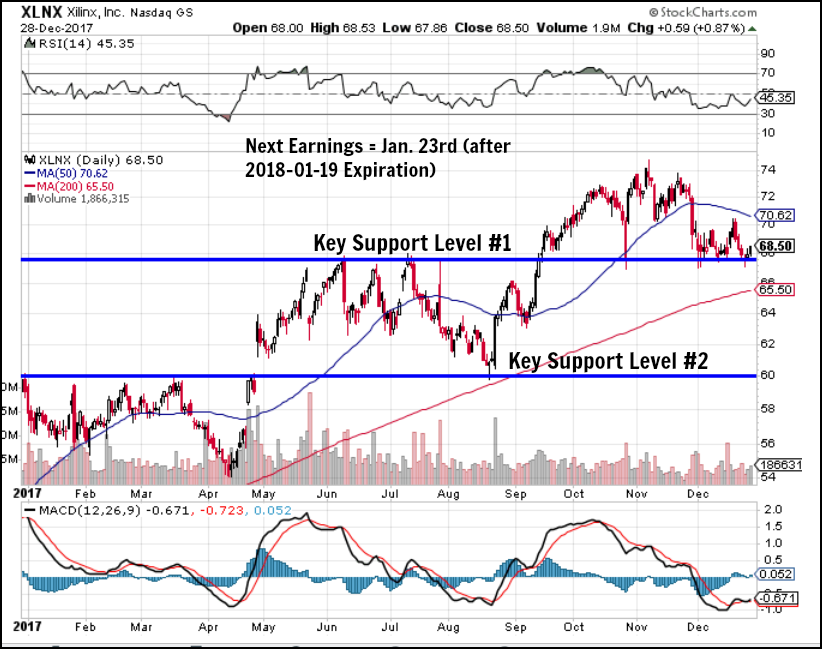
The stock was hitting several of our trade selection criteria:
- I felt the XLNX was reasonably valued for its growth prospects
- Shares were trading off a key technical support level (@ $67.50/share)
- It's hard to see in the chart, but the MACD Histogram (blue bars behind the MACD) had also recently started moving higher
- Option premium pricing was attractive
And the trade worked out beautifully.
On 2019-012-29, with XLNX trading @ $68.06, I sold a single JANUARY 19 2018 $67.50 PUT for $1.25/contract (or $125 before commissions).After commissions, I collected $117.28 in premium, which translated to a pretty robust 30.20% annualized ROI projected over the following 21 days until expiration.
But the trade didn't go 21 days.
In fact, just 7 days later, XLNX was trading @ $73.91/share, and I bought back my JANUARY 2018 $67.50 SHORT PUT for just $0.17/contract.
After commissions, I booked final profits of $92.56 on $6750 of cash-secured capital over 7 days for a way outsized 71.50% annualized ROI.
So a classic example of being able to lock in a majority of the trade's max potential gains ($92.56 vs. $117.28, or 78.92%) in a fraction of the original expected holding period (7 days vs. 21 days, or 33.33%).
Example #2 - Early Exit of Winning NWL Put Selling Trade Based on Remaining Time Value
Another Club trade - this one took place in January 2018.
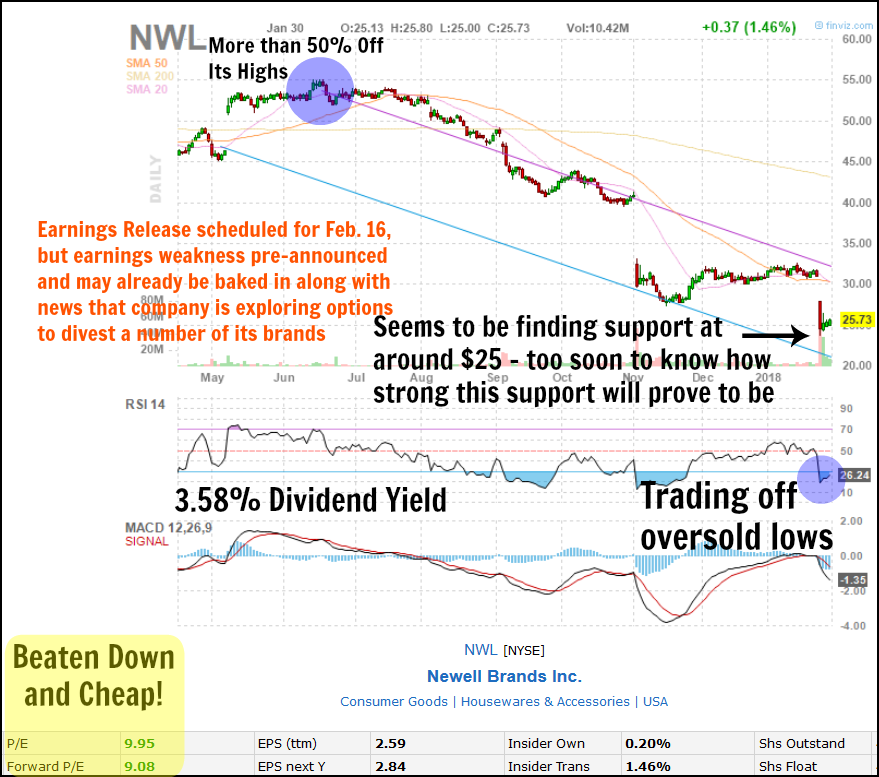
- The set up here was a little unusual in that it involved selling a put during an expiration cycle that included an earnings release - something we almost always avoid doing.
- But the previous week, NWL lowered guidance and announced initial plans to close factories and sell off smaller brands, focusing instead on 9 larger, core brands (similar to a strategic approach that PG successfully undertook on a much larger scale a couple years prior).
- The stock immediately sold off more than 20% but then seemed to find its footing (i.e. support) around the $25 level.
- While the MACD Histogram was more flat than moving higher, the stock was technically oversold per the RSI reading (see chart above).
- Additionally, the sell off in the stock resulted in a very attractive 3.58% dividend yield, would might also help support the stock
So in this rare instance - because I felt that all the negatives were known and priced in ahead of earnings - I was OK with selling a put for a duration that included a quarterly earnings release.
On 2018-01-31, with NWL trading @ $25.75/share, I sold (2) MARCH 16 2018 $25 PUTS @ $1.15 for $221.50 after commissions - or 36.75% annualized projected over 44 days until expiration.
And how did the trade work out?
As with the XLNX trade above, I also exited this position after just 7 days.
With shares having climbed from $25.75 to $29.77, I bought back the pair of MARCH 2018 $25 SHORT PUTS for $0.35/contract).
Final returns were $143.02 over 7 days (vs. original projected returns of $221.50 over 44 days).
So in this case, I locked in 64.57% of my max potential gains in just 15.91% of the original expected holding period - and the astronomical 149.15% annualized ROI (vs. the original projected 36.75% annualized ROI) really bore that out.
Using Technical Analysis to Exit a Short Put Trade Early
There's another reason why it may make sense to close a winning or successful put selling trade early - because the technicals tell you to.
As a reminder, the best use of technical analysis, in my view, is not to try to use it as a crystal ball to predict what will happen.
The best - and most realistic - use of technical analysis is to simply identify what's more likely to happen in the near term and what's less likely to happen.
As you'll recall, when selling puts, you want to look for what I call Limited Downside Situations - or multiple reasons why a stock is unlikely to trade lower, or lower by much, in the near term.
And technicals will often be a big factor (i.e. trading near and off a support level, a rising MACD Histogram, and a little icing on the cake is an oversold RSI reading of 30 or lower to boot).
But what happens if you sell a put, the underlying stock moves higher (which we like, of course) and conditions eventually change so that the stock looks more like it's facing a Limited Upside Situation?
Again, we never truly know what Mr. Market is going to do next, but when a stock is facing identifiable technical headwinds (trading at or near resistance, a falling MACD Histogram, or an overbought RSI reading of 70 or higher), it's often a good time to pack up camp and look for the next opportunity.
The good news is that this scenario is the result of a winning trade that will allow you to book gains, not the result of a trade that's falling apart.
The best way to illustrate the idea of using technical analysis to let you know when to exit a winning naked put trade early is with an example, of course.
Example #1 - Using Technicals to Close a Successful ORCL Short Put Position Early
This was a nice put selling set up we found in the spring of 2018 on ORCL:
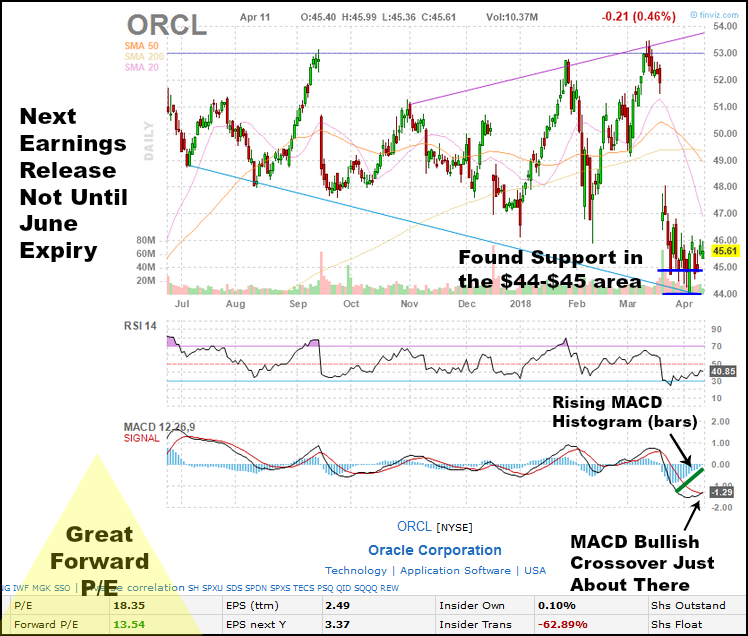
- The valuation was attractive
- There was solid support in the $44-$45 area which the stock had recently bounced off of
- The MSCD Histogram was moving higher
- And there was no earnings exposure for a couple of months
On 2018-04-12, with ORCL trading @ $45.82/share, I sold or wrote a single MAY 18 2018 $45 PUT FOR $0.90/contract ($82.28 after commissions) for a very solid 18.54% annualized return projected over 36 days until expiration.
One week later, ORCL was trading @ $47.01/share and I chose to exit the position early by buying the $45 short put back for $0.35/contract.
As with our previous examples, I was able to lock in a majority of the trade's maximum potential profits in an abbreviated holding period (first selling the $45 put for $0.90/contract and then buying it back one week later for $0.35/contract).
But commissions took a chunk out of this trade at both ends - while the final annualized ROI was a pretty sweet 45.84% over 7 days, on a total dollar basis, the trade brought in a relatively small amount of profits.
In fact, I only netted $39.56 on the trade.
So why not give this one more time to burn off more time value/premium?
If you look back at the chart above, when ORCL traded higher (I exited at $47.01/share), I felt that the $47 level could function as resistance.
In fact, that's exactly what did happen and the stock did pull back in late April and early May 2018.
The stock even (briefly) traded below $45 - the strike price of my short put - in early May, although it didn't stay down there for very long.
So the trade would've been fine if I'd just left it alone.
My $45 short put would've (briefly) traded in the money, but at the end of the day (i.e. the May 18 2018 expiration date), the put would've expired worthless and I would've booked my entire maximum gains.
But I would make the same move every single time.
Anything can happen, of course, but if the technicals are telling you there's likely more downside risk to a stock than upside risk, and you have the opportunity to walk away and lock in a profit, that's always the smart move.
And - again - this example shows the best use, and effectiveness, of technical analysis. Without foretelling the future with eerie precision, the technicals still gave me an early warning that risk to the trade had increased.
Example #2 - Using Technicals to Close a Successful CROX Naked Put Trade Early
Here's another good example of how technical analysis can make your decision to exit a successful put selling trade early very easy.
Again, a classic set up for us . . .
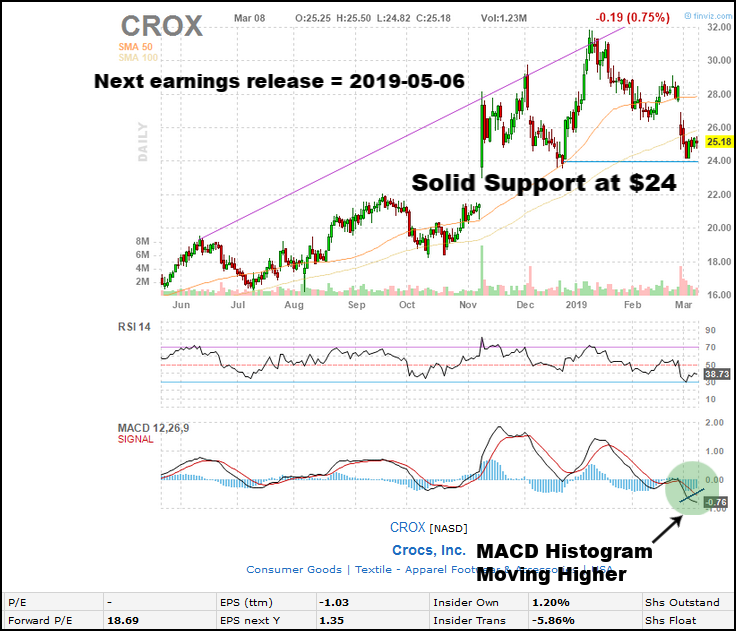
- The company had recently reported earnings (translation: no earnings exposure for new trade)
- Earnings number and growth were both good, but forward guidance was weaker than anticipated and the stock plunged
- But . . . the sell off seemed contained by the stock testing and holding support at the $24/share level
- Our favorite timing indicator - the MSCD Histogram - had also begun moving higher
- Additionally, implied volatility levels in CROX options were nice and plump (which meant we would be compensated very well for our services)
So on March 11, 2019 with CROX trading @ $25.12/share, I Sold to Open (2) CROX APR 18 2019 $24 PUTS @ $0.85/contract.
After commissions, the position brought in $167.71 in net premium - or a 33.56% annualized rate projected over the following 38 days until expiration.
Fast forward 22 days and CROX was trading @ $26.53/share and (as you can see in the original chart above) right back into the heart of a near term but still likely major resistance zone around $26.50-$27/share.
$26.50-$27 is the general area where the stock had found support back in the first half of February as well as the area that it initially gapped down to when it sold off in the wake of the poorly received earnings release at the beginning of March.
When you add together all the factors - the passage of time (22 days out of 38 days had passed), the stock trading higher (from $25.12/share to $26.53/share), and shares running into a well defined resistance area (in fact, the stock was actually down a bit that day), it made a lot of sense from both a risk and reward perspective to book our profits and exit the trade early.
So on April 2, 2019, I bought back the 2 CROX $24 SHORT PUTS just $0.15/contract (recall that I originally sold or wrote them for $0.85/contract.
Final booked profits = $137.43 of $4800 of cash-secured capital over 22 days for an outstanding 47.50% annualized return (a big improvement over the original projected 33.56% annualized ROI if held until expiration).
In the days that followed, CROX did show some signs of weakness as the stock pulled back to a little below $26/share before consolidating and moving back above $27 at expiration.
So the trade would've been fine if simply left alone.
But it was still the right move to close the trade early.
The technicals clearly indicated that the put selling oriented Limited Downside Situation had run its course and had flipped to a Limited Upside Situation.
In fact, throughout the first half of April, the MACD Histogram had actually started moving lower as the stock retraced back toward the $26 level.
But I also made money at a much higher rate (47.50% annualized vs. 33.56% annualized) and then freed up my capital early to go out and find another opportunity.
Overlapping Factors
It's probably already occurred to you that these two factors we use to determine when it makes sense to exit a successful put selling trade early - remaining time value and the current technical picture - often overlap.
If you sell a put and then the stock spikes so that it's now running into technical resistance at a materially higher strike price, then there's also a very good chance that the short put will have already lost a lot of extrinsic or time value.
Here's a really good example . . .
In mid-March 2019, I tracked down a put selling opportunity on ALK (Alaska Airlines) for Club Members and posted the following two charts:
CHART #1
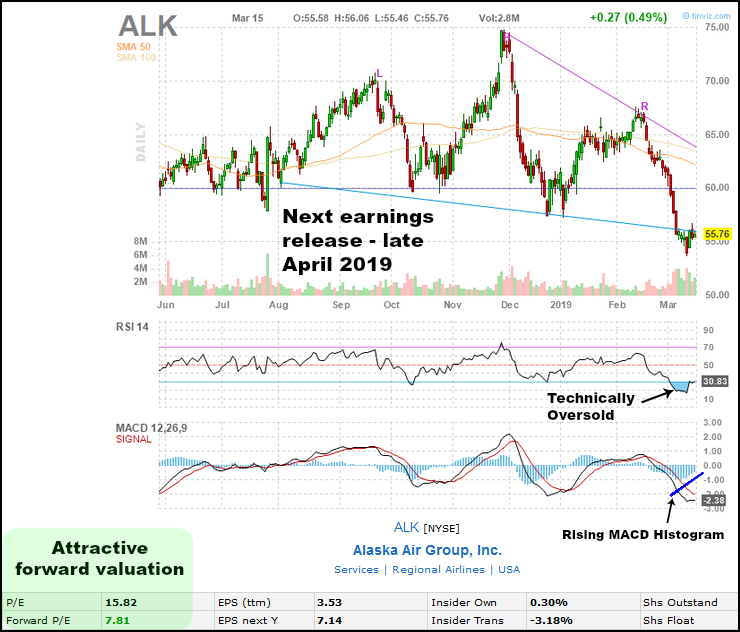
CHART #2
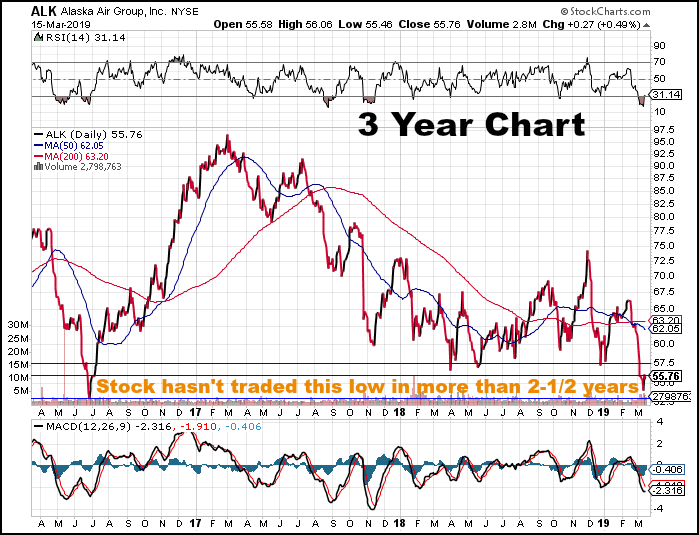
Again, pretty sweet set up where the specific criteria we look for when selling puts all lined up nicely for us:
- No earnings on the horizon (until after the April 2019 monthly expiration cycle)
- While the stock had recently broke longstanding support in the $56-$57.50 range a few trading sessions earlier (see Chart #1), there was another longer term support level at around $52.50 (see Chart #2) that wasn't violated as ALK pretty quickly bounced off the $54 level
- It also looked like airlines as a group were bottoming (or had already bottomed)
- Specifically with ALK, in addition to the attractive forward valuation, we were also looking at a technically oversold stock and a rising MACD Histogram
- In fact, I was very comfortable initiating a new short put position at the $55 strike - there was plenty of premium available and I expected the position would be relatively easy to manage even if the stock did trade lower (especially with longer term support right around the corner @ $52.50)
How did the trade work out?
In a word . . . spectacularly.
On 2019-03-18, with ALK trading @ $55.82/share, I sold or wrote a single ALK APR 18 2019 $55 PUT for $1.15/contract or $113.85 after commissions for a nice, plump 24.37% annualized rate projected (on $5500 of cash-secured capital) over the following 31 days until expiration.
18 days later, the stock had climbed to $58.63 and was nearing what I saw as a likely resistance level. Additionally, the MACD Histogram had begun to flatten out.
Remaining time value had also taken a big hit.
I'd originally sold the $55 put for $1.15/contract (on a 31 day expected duration), but was able to buy it back for $0.25/contract (with no commissions on short option closing trades on the TastyWorks brokerage platform) after 18 days.
Exiting the trade early with the bulk of the gains locked in obviously boosted the final annualized ROI, which ended up being 32.71% annualized over those 18 days.
Does Remaining Time Value and Changing Technicals Always Overlap?
They often do, but it's not always the case.
From personal experience - and the math behind this should also make sense - it really depends on two factors:
- The original duration of the trade
- Implied volatility pricing of the options in question
Let's take these two factors one at a time . . .
Original Duration of the Trade
It's pretty simple.
All things being equal, the closer a put is to its expiration date, the more time value it will lose if the underlying stock moves higher. That's because there's simply less time on the clock for the stock to reverse course and challenge the strike price in question.
Conversely, when you've got a longer duration to work with, a similar move higher by the underlying stock will have less of an impact on the value of a short put at the same strike.
With the Sleep at Night Strategy, our trades are typically set up somewhere in the range of 3 weeks to 45 days - basically we go with the nearest monthly expiration cycle until that one gets too close at which point we then move to the next monthly cycle.
As a reminder, the duration you pick for a trade has to strike a balance between total premium collected (the farther out you go, the more total premium you collect) and annualized rate of return (the nearer expiration is, the higher your annualized ROI will be. I've personally found that 3 week to 45 day range to be the best balance between these two opposing factors.
The ORCL $45 short put trade above is an excellent example.
It wasn't at the very edge of a longer duration trade for us, but at 36 days, it was set up as a 5+ week trade.
That means when I exited the position 7 days later (after the stock had climbed from $45.62 to $47.01), there was still another 29 days until expiration.
Yes, the put had obviously lost considerable value ($0.90/contract vs. $0.35/contract), but with nearly a month remaining until expiration and the $45 short put only a couple bucks out of the money, it certainly wasn't plausible to expect the put's value to completely collapse.
Implied Volatility Levels
Similarly, the implied volatility levels (or the actual pricing of an option) will also have a big impact.
Again, this should make sense
All else being equal, a high IV put option (e.g. the options of a biotech stock) will lose less relative value vs. a lower IV put option (e.g. the options of a consumer staple type stock) if or when the underlying stock makes a big move higher since it take a lot more to move a lower volatility stock than a higher volatility stock.
Part 2 - Managing and Repairing a Losing Put Selling Trade
In one of my favorite television shows of all time, Northern Exposure, there's an episode in Season One ("A Kodiak Moment") where Joel (Dr. Fleischman) is teaching a childbirth class in another small Alaskan town.
He tells the expectant mothers that the best preparation they can make is to memorize these four words (and to practice saying them adamantly): "I WANT MY EPIDURAL!"
When it comes to option trading I have a similar phrase that I would encourage you to internalize (although it's comprised of five words rather than four):
"Never Lose Money Selling Puts!"
Easier said than done?
Now, as we've seen in Part 1 of Chapter 6 of this Ultimate Guide for Finding and Managing Great Put Selling Trades, that's pretty easy when everything goes according to plan.
When that happens, as we've covered in depth, the main challenge is learning to manage these successful trades as efficiently and as effectively as possible.
But what happens when you sell a put on a stock and then - gasp! - the stock trades the wrong way on you?
Well, that's exactly what we're going to cover in Part 2 of Chapter 6:
How to take "losing" trades and not just claw them back to some kind of breakeven status, but to really repair them so that you almost always still walk away with decent to good POSITIVE returns when the dust finally settles.
Our Two Trade Repair Objectives When a Put Selling Trade Moves Against Us
For in the money short put positions (i.e. the underlying stock is now trading below the strike price of the put we've sold) when it comes time to roll or adjust, we have two clear cut objectives:
- We want to roll the position for a net credit
- We also want to lower the strike price whenever possible
We also don't want to have to roll our position out to a ridiculously far out future expiration date.
My general rule is I don't want to go out farther than 3 monthly expiration cycles, but sometimes the monthly options three months away aren't available and a four month roll becomes necessary.
And, of course, there can always be exceptions to the rule and you have to take your trades on a case by case basis. I have, in fact, kicked a trade out longer than 3-4 months and I have accepted a "strategic" net debit on an adjustment if I felt it was in the trade's best interest.
But the rationale behind our objectives here is pretty clever - and effective.
The more we're able to lower the strike price on the trade, the less the stock has to "come back" in order for the position to eventually expire worthless (or we buy to close it cheaply).
And the more net premium we accumulate over the life of the trade/campaign, the greater our final profits will be.
TIME OUT - WHAT IS A NET CREDIT WHEN ROLLING OPTIONS?
A net credit on a roll occurs when you receive more for selling your new put (at a later expiration date) than what it costs you to buy back or close your old or expiring short put.
For example, here's a 2018 campaign or series of rolls I did on SONC (since acquired by private equity firm Inspire Brands who also owns Buffalo Wild Wings)::
>> On 2018-01-17, with SONC trading @ $26.03/share, I sold (2) SONC FEB 16 2018 $25 PUTS for $0.50/contract (or $100 before commissions)
>> On 2018-02-16, with SONC trading a little below that strike price @ $24.87/share, I rolled the position straight out to the MARCH 16 2018 $25 STRIKE for a $0.65/contract net credit
>> (I bought back my (2) FEB $25 SHORT PUTS for $0.22/contract but received $0.87/contract for selling/writing the (2) new MARCH $25 SONC PUTS)
>> 21 days later on March 9, 2018 with SONC trading a little lower @ $24.82/share, I once again rolled the position, this time down and out to the (lower) $22.50 strike and out to the JUNE 15 2018 monthly expiration cycle for a $0.50/contract net credit
>> (I bought back my (2) MARCH $25 SHORT PUTS for $0.38/contract but received $0.88/contract for selling/writing the (2) new JUNE $22.50 SONC PUTS)
>> 98 days later (expiration day, June 15 2018) SONC closed above $26/share, and my (2) $22.50 short puts expired worthless
>> After commissions, I booked $251.46 in final profits on a daily averaged cash-secured capital base of $4671.14 (51 days @ $5K and 98 days @ $4500), or 13.19% annualized over 149 days)
(Not bad on a trade where the original thesis - that the stock wouldn't trade below $25/share - was wrong.)
What Impacts Your Ability to Generate Net Credits on Rolls and Adjustments?
One of the keys to effective short put trade repair is having a clear understanding of the factors involved in generating net credits or net premium on your rolls and adjustments.
And this all goes back to the dynamics of option pricing which we covered in Chapter 2.
As a reminder, the price of a put option consists of intrinsic value (if it has any), which is the amount that the underlying stock is currently trading below the strike price of your put option + any extrinsic or time value.
And the time value of an option is impacted by a number of different factors:
- Time remaining until expiration (hence the name!)
- Proximity of the strike price to the current share price (options nearest the current share price will ALWAYS have the highest amounts of time value - and the farther away a strike price is away from the current share price - either above or below, it doesn't matter - the less time value it will have)
- Overall implied volatility (IV) pricing (at any given moment, Mr. Market is pricing into a stock's options how volatile he expects the underlying stock to trade during the period of that option's remaining lifespan - the more volatility he expects, the more time value there will be)
Why This Matters When Repairing Naked or Cash-Secured Puts
You can probably see where we're going with this . . .
If you're rolling an at or near the money short put where the current share price and the strike price of your put are very close to one another, you're going to get a much larger net credit than if you're rolling a short put that's deeper in the money.
In fact, the deeper in the money your short put trades, the farther out in time you may have to roll in order to generate a net credit.
Once you've really internalized those three time value pricing factors above, the clearer you'll be when it comes to understanding the trade repair potential and limitations of different scenarios.
For example . . .
Rolling will be easier (i.e. you'll get a better net credit and/or you won't have to roll out as far) if you're working with, say, an in the money short put trade on an airline stock vs. a consumer staple stock even if both trades are equally in the money.
That's because an airline stock is going to have much higher implied volatility pricing than a consumer staple stock (unless there's something specific to and unusually bearish re: that consumer staple stock).
In a weird way then, higher IV short put options can be easier to manage and repair when they get into trouble than the short put options of more boring and "safer" stocks.
In fact, with one of our Hall of Fame Trade Repairs - which I refer to as the Legendary ANF Trade - the stock plunged 49.94% on me from my original entry point to its closing lows.
And yet I still walked away with 30.66% total returns over 487 days (or 22.98% annualized) even as the S&P 500 was actually down slightly over the same time period.
A lot went right with this trade repair, but because there the IV levels in ANF (troubled teen retailer Abercrombie & Fitch) options were so high, I was able to systematically work the strike lower over time from $30 all the way down to $22 - while still generating a lot of net premium along the way
= = = = = = = = = = =
In contrast, we've had a handful of trades over the years on more defensive type stocks where - and the question was never about whether we were going to make money or lose money - the final returns were much more subdued.
A good example is what turned out to be a 221 day trade on SO (electric utility The Southern Company).
We originally (on 2018-01-08) sold a FEB 16 2018 $46 put on SO and basically kept rolling the position for a little more than 7 months for modest net credits as the stock spent much of the first six months of 2018 trading in the low $40s.
(Had SO options had higher IV levels, we might have been able to roll down and out to a lower strike at some point which then would've resulted in even better future rolls and adjustments.
That's another huge key and component to put selling trade repair - the more you're able to lower the strike price when rolling your in the money short puts, the easier ALL future rolls and adjustment become - even if it doesn't seem like it at the time.
Put Selling Trade Repair Super Weapon
In Chapter 5 of this Guide, Best Position Size When Selling Puts, I mentioned that under certain circumstances, we would actually add contracts to an existing - and in the money - short put position as part of the trade repair process.
(Hence our practice of relatively small initial position sizes.)
This may sound a little scary at first (doubling down, throwing good money after bad, sticking with a losing trade, etc.), but it can be remarkably effective when done correctly.
(Good news - with our Trade Repair Formula and Adjustment Timing Cheat Sheet, there's no guesswork when it comes to determining what adjustment to make and when to make it.)
Expanding a trade is based on something I call the Double Half Principle.
By doubling the number of contracts in an in the money (underwater) short option trade, you can effectively cut in half the distance between your strike price and the current share price.
Huh?
Let's say you've sold or written a $50 put on a stock and then, at some point, the damn stock is trading all the way down at $40/share.
Yikes - you're theoretically on the hook to buy 100 shares of a (now) $40 stock for $50/share.
In my view, the stock market is 75% psychology and only 25% math.
So the natural instinct in the above scenario is for the put seller to freak out and feel like $%$% - and lock in a big loss before the trade gets any worse.
(Or simply allow assignment and then start selling covered calls at much lower strikes and then pray you don't get whipsawed if the stock rebounds at some point.)
But let's take a deep breath and consider the relatively simple math here . . .
If the underlying stock is trading @ $40/share and you have a $50 short put, that put is $10/contract in the money.
In other words, it contains $10/contract of intrinsic value.
Guess what else also has $10/contract of intrinsic value?
(2) $45 short puts.
So by simply adding a single contract to your trade, you can adjust or convert the trade so that you work the strike price lower by $5/contract.
In this example, that covers 10% of the underlying stock's decline right there.
That's Why Position Size Matters
Do you remember that story about the power of compounding returns where a king is going to reward one of his subjects for some great deed he did?
The guy is very shrewd.
He asks for very little - just a single grain of rice on the first square of a chess board - and then to keep doubling the amount of rice on each subsequent square.
Before he gets halfway through the board, he owns the entire kingdom.
Doubling something minuscule is no strain - at least at first.
But when you start expanding something that's already of significant size, that's when you may run into trouble.
Powerful but Rare
Expanding the number of contracts of an in the money short put position is a very powerful technique when done correctly and at the right time.
I first discovered the enormous potential when I sold a $70 put on DVN back in 2015 (lol - just when the energy crash was getting started).
Before I knew it, DVN was trading in the mid-$50s!
But it was a total light bulb moment when I saw that I could roll the position out three months for a very small net credit and work the strike price all the way down from $70 to $62.50 simply by adding a second contract.
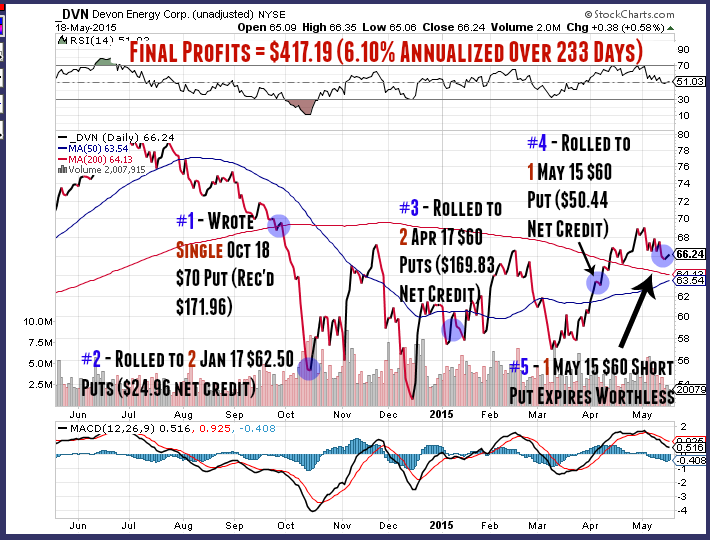
But with our Trade Repair Formula, the idea is that we only go that route very late in the process and only when the stock has moved very far from us.
That serves three subtle but powerful functions:
- It preserves capital
- It gives the stock time to bottom
- It guarantees that when we do employ this technique, that we get a much bigger bang for our buck
From personal experience I can tell you one thing for sure - the correct use of this technique is absolutely brilliant!
The ability to repeatedly, continually, and systematically lower the strike price on your in the money short put positions - without blowing through a ton of capital in the process and while still accruing additional net premium every time you touch the trade - gives you an insane advantage in the stock market.
Managing an ITM Short Put vs. Repairing an ITM Short Put
If you're used to selling puts and then simply allowing assignment of the shares if the trade goes against you and then trying to recoup your losses by selling covered calls (and hopefully not getting whipsawed in the process), the idea that you can consistently repair your "losing" trades may take a while to wrap your head around.
And you may be wondering just how many, or what percentage, of put selling trades realistically will need to be repaired?
Now, as the customized and specific put selling strategy (The Sleep at Night High Yield Option Income Strategy) that I've laid out here in this Guide is principle based and "informed decision making" oriented, and not a rigid or mechanical approach, results are naturally going to vary.
But I think you'll find it helpful to know the breakdown of our official Club trades and how they work out, how many require repairs, etc.
And I also think it will be helpful if I define some terms first in order to get the most accurate picture.
I basically separate trade outcomes into three categories:
- "Right" Trades are single leg trades that go off without a hitch - we sell a put and the stock continues trading above the strike price of our short put so that it either expires worthless or we're able to buy back that short put and exit the trade for a profit
- Managed Trades are trades with more than one leg - meaning we've rolled it at some point, either straight out for a net credit, or down and out to a lower strike for a net credit, but where we DO NOT need to expand the trade with more short put contracts
- Repaired Trades are trades with more than one leg (i.e. at least one roll) and which DOES involve expanding the number of contracts
The takeaway here is that I'm making a distinction between trades that just need to be managed a little (with simple rolls) in order for us to secure our rightful profit and trades that require what I consider to be repairs (which involve actually expanding the size of the trade to help facilitate those repairs).
How Many of Our Option Selling Trades Need to be Repaired?
Surprisingly few.
I should note that from May 2018 onward, we've also been selling small, conservative bear call spreads on Limited Upside Situations as conditions warrant.
The trade selection process is very similar for our call selling trades (when we don't believe a stock will trade higher, or higher by much, in the near term).
Take the technical criteria I spelled out for selling puts and simply flip them.
So we're looking for a stock struggling against or pulling back from a definable resistance level, a falling MACD Histogram, and, when we can get it, an overbought RSI reading of 70 or higher.
So, from the beginning of 2018 through the end of April 2019 - and these also include (8) open trades at the time of this writing, this is the breakdown of all our option selling trades:
- "Right" Trades = 63 (75.00%)
- Trades Needing to be Managed = 17 (20.24%)
- Trades Needing to be Repaired = 4 (4.76%)
What This Means and Why it's Powerful
There's actually quite a lot to unpack and consider with the above trade result breakdown.
First, less than 5% of our trades inside the Leveraged Investing Club ever require additional capital.
And even those trades where we do add contracts, it's usually only required once. So this is definitely not a situation where a trade becomes a money pit that we have to continually sink more money into in a desperate attempt to avoid an inevitable loss.
Just by the nature of our Limited Downside Situation approach and selection and set up criteria, we NEVER sell puts anywhere close to a top.
If we're wrong on a trade, it's almost always because we were early, not because we were actually wrong.
So as long as we follow the 4 Stage Trade Repair Formula AND the Timing Cheatsheet (more about that in the next section), hardly any of our trades will ever need any additional capital, and even those that do need it, won't need much.
Second, at the end of the day, we make money on virtually all (97.33% at present) of ALL our trades
To me, that's the far more important metric - what percentage of your put selling trades result in free and clear booked gains at the end of the day.
For us, that's currently 97.33% of our trades.
Sure, I would love to have nothing put perfectly behaved, super successful trades (because those generate bigger returns, require the least amount of involvement, and make me look really smart).
But at the same time, I'm also a grown up about real world trading.
So whether my trades go off without a hitch, need to be managed and massaged a bit, or require more proactive repairs, I don't care - the most important thing is that virtually all of them are profitable at the end of the day.
(Remember - when you book losses, you're investing in reverse.)
Bottom line - it's the 97% end of the day success rate I look at, not the 75% "right" rate where everything just dreamily goes exactly according to plan.
Third, in this case, our 75% "right" rate is vastly superior to others who claim to have 80%, 90%, or even higher winning trade percentages (not that these claims are always on the up and up).
For one thing, a lot of these folks are simply trading credit spreads with a certain statistical structure. Just because probability analysis says an option has 90% chance of expiring worthless, doesn't mean that's how these trades play out in the real world.
But it does mean that to get the probability numbers that overwhelmingly in your favor, you're going to need to sell your puts way out of the money (i.e. at strike prices well below the current share price).
The problem?
You don't get paid diddly for selling far out of the money options.
The workaround?
Leverage the hell out of your portfolio by loading up on credit spreads (e.g. bull put spreads, vertical put spreads, etc.) and make up the difference on volume.
Credit spreads are a double-edged sword.
They can be used to reduce risk, or they can be used to boost potential returns.
But they can't be used to do both at the same time - you have to decide which direction you're going to use spreads to move the Risk Dial.
For complete coverage about why this is, why credit spreads are so difficult to repair, the pros and cons, and the uses and misuses of credit spreads, be sure to check out this 4-part series on credit spreads.
So I would much rather have "only" a 75% "right" rate if I can still repair and book profits on virtually all the other trades I was "wrong" about rather than having a (allegedly) better "right" rate and then have my ass handed to me on the trades where I misread Mr. Market's intentions.
The 4 Stage Short Put Trade Repair Formula: Safe and Highly Effective Tool to Repair Put Selling Trades
Do you remember office supply company Staples' Easy Button campaigns?
It's tempting to use that as an analogy to the 4 Stage Short Put Trade Repair Formula (that I personally developed and fine tuned over several years with the invaluable assistance of a number of trades that exploded in my face!).
But, of course, the Trade Repair Formula isn't a single technique, tactic, or maneuver - it's four different buttons.




How the Put Selling Trade Repair Formula Works
Do you remember our twin objectives when dealing with a put selling trade that moves against us?
As we manage the trade, we strive to:
- Always roll for a net credit (i.e. collect more for setting up the new leg than what it costs us to close out the old or expiring leg)
- Lower the strike price whenever possible
The 4 Stage Short Put Trade Repair Formula helps us achieve these objectives - and, most importantly, in a safe and highly capital efficient manner.
If you have unlimited capital, you could simply keep adding contracts (i.e exploiting the Double Half Principle) and indefinitely adjust the strike price of your underwater short put trades that way.
But who has unlimited capital?
Doubling the number of contracts on a trade every time you roll it not only is a highly inefficient use of capital, it's also high risk because if you've burned through all your capital and the trade still isn't fixed, you've only managed to dramatically enlarge a losing trade.
The most compelling case for the 4 Stage Short Put Trade Repair Formula are these two statistics:
- 97% of our trades book profits at the end of the day
- Less than 5% of our trades ever require additional capital
The 4 Stage Short Put Trade Repair Formula wasn't, as they say, created in a day.
It wasn't something I just sat down and figured out in an afternoon.
And it's not something generic I found and then just renamed it.
It was years in the making, and it came from my willingness to embrace ugly trades and not let go until they revealed their secrets.
(Seriously - and this is true in any area of your life - our greatest "mistakes" are also our greatest teachers - if we have the courage to face them head on rather than try to pretend they never happened.
So the "formula" for creating a highly effective Trade Repair Formula was numerous ugly trades + courage + time.
Trade Repairs - What to Do and When to Do it
The best thing about the Short Put Trade Repair Formula - other than that it's safe, smart, and extremely effective - is its ease of use.
That's because I also developed an adjustment timing mechanism (i.e. cheat sheet/flow chart) that tells you exactly what adjustment to make and precisely when to make it.
It takes all the guesswork - and in the process, all the stress - out of the trade repair process.
Where to Get the 4 Stage Short Put Trade Repair Formula
The Trade Repair Formula (a 28 page pdf along with the corresponding one page ITM Short Put Adjustment Timing Cheat Sheet) is included in Lifetime Membership in the Leveraged Investing Club.
The Club only accepts new members periodically, and it's only offered to readers of the Daily Option Tips and Insights Newsletter (subscription is free and comes complimentary when you download any report or sign up for my free Secret Seminar program on this page).

Naked, Short, and Cash-Secured Put Resources and Pages
Whether you're brand new to put selling or you're looking to improve some aspect of your trading, there's a good chance you'll find what you're looking for below.
To make it easier, I've organized the articles below by topic. In many cases, the articles are part of a larger series that really drills down into some aspect of put selling.
Best of all, these are not boring, encyclopedic entries that simply regurgitate surface level cliches and conventional wisdom.
These are some of the most important insights - many of them contrarian - that I've gained from being a dedicated put seller for the past 15+ years.
Enjoy!
INTRO TO AND THE CASE FOR SELLING NAKED PUTS
Naked Put Basics - Writing or selling is often viewed in terms of insuring the price of someone else's stocks, or else as a mechanism designed to generate potential discounts on the acquisition of a stock. This article provides an introduction to naked or short puts, along with examples, scenarios, and variations of the trade.
How Does a Naked Put Lose Value? - Here we explore the only three ways that a short put can decline in value (which is what you want as a put seller) along with the type of situations you should look for to accelerate that process.
Why You Should Sell Puts - In this article I make two key points - that we're almost ALWAYS better off selling puts rather than buying stocks, and when you sell and manage puts the way we do, you're not so much insuring a stock at a certain share price as much as insuring against the possibility that the underlying business completely falls apart.
Less Risk Selling Puts - Better Returns with Less Risk with a Put Selling Campaign - The great thing about a put selling campaign is that it doesn't just reduce your risk, it can actually eliminate it. In this piece, I walk you through how I used a put selling campaign to lock in 15.51% annualized returns Over 172 Days on a high quality but struggling stock while significantly reducing my risks.
SERIES - HOW TO FIND GREAT PUT SELLING TRADES
Part 1 Naked Put Watch List - In Part 1 or this 3 part series on How to Find Great Put Selling Trades, I make the case for you building your own personal Naked Put Watch List - along with some important tips to make the process easy and effective.
Part 2 Selling Puts for Income vs. Discounts - If you're going to be successful selling puts, you need to be 100% clear - and unapologetic - re: why you're selling them in the first place. Ignore the wishy-washing platitudes of generic put writing and take a stand - are you selling puts for income, or are you selling them in order to generate discounts on your favorite stocks?
Part 3 Flexibility and Psychology in Selling Puts - What can the 2014 film "The Imitation Game" teach you about finding great put selling trades? In this concluding article in our three part series, I make the case for adopting an attitude of flexibility - if you're going to crack Mr. Market's code, you need to understand him both at a mathematical level and a psychological one.
Put Selling Trade Selection - When selling naked, short, or cash-secured puts, which factor is the most important? Fundamentals? Technicals? Valuation? These (and more) are all important, but in my experience, one factor really outweighs the others.
REPAIRING IN THE MONEY SHORT PUTS
Repairing Short Puts - Heads You win, tails Mr. Market loses. With the right option trading strategy - which in my biased opinion is the customized put writing strategy I've developed and fine tuned over the last 15 years - you no longer have to play by everyone else's rules. In this article I share the four possible outcomes of my trades - and explain how, at the end of the day, each one is profitable.
Short Put Trade Repair - The Pros and Cons of Repairing Short Puts - I rarely, if ever, book a loss selling puts at the end of the day. Is there a catch? Too good to be true? What are the trade offs - the pros and cons - of attempting to never have a losing trade?
The 4 Stage Short Put Trade Repair Formula - The 4 Stage Short Put Trade Repair Formula is a 28 page special strategy guide included in the Sleep at Night High Yield Option Income Course inside The Leveraged Investing Club. It's designed to take the stress and guesswork out of the trade repair process while making sure that we get the most effective use of both our capital and time.
Emotional Impact of Short Put Trade Repair - Yes, it's great when a difficult trade is over and we see that we have, in fact, outsmarted and outplayed Mr. Market yet again. But while we're in the midst of such a trade, it isn't confidence and superiority we often feel but rather turmoil and a sense of ill foreboding. So how do you handle that inner turmoil if it rears up while you're riding out and repairing a challenging trade?
SERIES - NAKED PUTS VS. CREDIT SPREADS (BULL PUT SPREADS)
Part 1 Why Credit Spreads Are So Hard to Repair - In this introductory article in our Naked Puts vs. Credit Spreads series, we explore what makes a bull put spread different from a cash-secured put, why selling puts (and covered calls) is the most forgiving option trading available, why most credit spread traders choose bull put spreads over selling cash-secured puts (hint - it's not about risk control), and why credit spreads are so damn hard to repair.
Part 2 Uses and Misuses of Credit Spreads - The best use of a credit spread like a bull put spread - because it's the safest - is to treat it as a regular cash-secured puts. And an examination of the traditional insurance business model helps to illustrate.
Part 3 Credit Spread False Logic and Faulty Math - It can be maddening when you constantly hear credit spreads touted to new option traders as both low risk AND high return. They can be one or the other, but they can't be both at the same time. And how exactly does Dave Righetti's 1983 no-hitter on the 4th of July for the New York Yankees tie in to all this?
Part 4 Safe Sanctuary for Credit Spread Refugees - The high potential risks of credit spreads is not an abstract concept because the capital that gets ignited when a credit spread goes south impacts real human beings. In this article, we take a look at some of those real life credit spread disasters and where you can go if you ever find yourself becoming a credit spread refugee.
SERIES - SELLING PUTS AND EARNINGS
Part 1 Selling Puts Into Earnings - I don't sell puts into an earnings release. There are always exceptions to any rule, but in general I avoid initiating any new short put trades that include earnings. This article explains why and includes a scary chart to really illustrate the point.
Part 2 How to Use Earnings to Manage and Repair a Short Put Trade - OK, but what if you're already in an existing short put trade and earnings comes back around? This article shows you how to use the earnings calendar to your advantage to manage or repair and existing naked put position.
Part 3 Selling Puts and the Earnings Calendar - A weird but important tip to conclude our Selling Puts and Earnings series: Always verify an earnings release date in the Investor Relations section of a company's website. Just because your online broker or other financial website lists a specific date, that doesn't mean it's the correct date.
SELLING PUTS AND TECHNICAL ANALYSIS
How to Use Technical Analysis to Sell Puts - Here's a great example of why I love basic technical analysis and how to incorporate it into the selling of puts. In this example, it resulted in me doubling my annualized returns, allowed me to ring the register twice on a trade, and my capital was still freed up more than a month early.
Using Basic Technical Analysis to Sell Puts - Another example of how using basic technical analysis to time put selling trade entries and adjustments resulted in short term, but lucrative returns.
Technical Analysis and Selling Puts - When it comes to trading, how many investors are missing out on what's right in front of them? In this article, I show how basic technical analysis helped us know when to enter a trade, when to hold steady when an out of the blue crisis emerged, and then, finally, when to exit the trade for excellent 26.03% annualized returns over 32 days.
OTHER IMPORTANT PUT SELLING ISSUES
Best Position Size When Selling Puts for Income - So what's the best position size when selling puts for income? In this article, I'm going to explain what works best for me and why, have some fun discussing rules vs. principles, and end with a couple of real world examples to illustrate what I'm talking about.
Selling Puts on Value Stocks vs. Selling Puts on Growth Stocks - As a put seller, you have to make a choice - are you going to sell puts on value oriented stocks, or are you going to sell puts on growth type stocks? In this article I make the case put selling on more value oriented stocks, but I also present the case for growth stocks and offer suggestions to lessen your risk if you go that route.
When Not to Sell Puts - In this article, I share a cool stock market adage from Jeffrey Saut of Raymond James and show you how it helped me perfectly time a trade and score an insanely high annualized rate over a 3 day holding period (or if you prefer, how I was able to capture 60% of a short put trade's potential gains in just 5% of the original expected holding period - 3 days vs. 81 days).
Selling Puts on Margin - Should you use margin selling puts? In this article, we explore the pros and cons of using margin, why those new or relatively new to the strategy should stick with cash-secured puts until they've gained experience, how margin affects the trade repair process, and the absolute worst use of margin in my view.
Selling Puts on Unprofitable Businesses - When you sell puts on the stock of an unprofitable business, you're working without a safety net - in this article, I explain why I finally stopped selling puts on struggling teen retailer Abercrombie & Fitch (ANF), even though I made fantastic returns for a long time.
Should You Sell Puts on Leveraged ETFs? - I was contacted by a long term reader of the Daily Option Tips and Insights Newsletter who wanted to discuss selling puts on leveraged ETFs. In this article, I share some of my thoughts on the strategy as he laid it out, identify the potential risks, explain why it doesn't quite gel with the approach teach and advocate, and then provide some ideas to make it safer and more effective for anyone who does want to go this route.
PUT SELLING EXAMPLES AND CASE STUDIES
How I Doubled My Annualized ROI on an ORCL Short Put Position - Here we dissect a real world trade where I essentially doubled the annualized returns on a cash-secured put position in order to look more closely at when the annualized metric (which I love) matters and when it doesn't.
Put Selling Questions
From the Trading Options FAQ Section . . .
Writing Naked Puts vs Covered Calls - Is There Really a Difference?
Advantages of Writing Naked Puts over Covered Calls
Writing Cash Secured Puts on Stocks You Don't Want to Own
Turning a Naked Put Into a Covered Put After the Put Has Gone In the Money?
Repairing Naked Puts - Why Stick with a Losing Trade?
Closing Options Early (Naked Puts/Covered Calls)
Tweet
Follow @LeveragedInvest

HOME : The Complete Guide to Selling Puts





>> The Complete Guide to Selling Puts (Best Put Selling Resource on the Web)
>> Constructing Multiple Lines of Defense Into Your Put Selling Trades (How to Safely Sell Options for High Yield Income in Any Market Environment)
Option Trading and Duration Series
Part 1 >> Best Durations When Buying or Selling Options (Updated Article)
Part 2 >> The Sweet Spot Expiration Date When Selling Options
Part 3 >> Pros and Cons of Selling Weekly Options
>> Comprehensive Guide to Selling Puts on Margin
Selling Puts and Earnings Series
>> Why Bear Markets Don't Matter When You Own a Great Business (Updated Article)
Part 1 >> Selling Puts Into Earnings
Part 2 >> How to Use Earnings to Manage and Repair a Short Put Trade
Part 3 >> Selling Puts and the Earnings Calendar (Weird but Important Tip)
Mastering the Psychology of the Stock Market Series
Part 1 >> Myth of Efficient Market Hypothesis
Part 2 >> Myth of Smart Money
Part 3 >> Psychology of Secular Bull and Bear Markets
Part 4 >> How to Know When a Stock Bubble is About to Pop